



PCI DSS Compliance and Assessment

Achieve and Maintain PCI DSS Compliance
Organizations that store, process, or transmit payment card data must meet PCI DSS requirements. HALOCK PCI DSS compliance services help organizations determine what applies, define scope, identify gaps, implement remediation, validate controls, and maintain compliance.
HALOCK’s Qualified Security Assessors combine PCI expertise with cybersecurity and risk-management experience so clients can address requirements without losing sight of the risks those controls are designed to reduce.
“Extremely happy with the services. Exceed expectations in all areas of the project.”
– Chocolate company

Why Choose HALOCK for PCI DSS Compliance Services?
HALOCK QSAs bring technical, compliance, risk, and forensic experience to PCI engagements, The team are experts in the PCI DSS framework and also specialize in Duty of Care Risk Analysis (DoCRA), our proprietary methodology recognized in breach litigation
HALOCK helps organizations:
- determine PCI DSS scope;
- identify cardholder data flows;
- evaluate third-party service providers;
- assess readiness;
- identify compliance gaps;
- develop remediation plans;
- perform Targeted Risk Analysis where required;
- prepare SAQ or ROC documentation;
- support validation;
- maintain compliance after assessment.
HALOCK also applies DoCRA principles where appropriate to help organizations select controls that are not only compliant but reasonable and defensible.
PCI DSS Scope and Preparedness Assessment
Correct scope is one of the most important parts of PCI DSS compliance.
HALOCK identifies payment channels, cardholder data flows, systems, service providers, and other components that may fall within the Cardholder Data Environment. Where appropriate, HALOCK helps reduce unnecessary scope through segmentation, data removal, outsourcing, or other architecture and process changes.
A PCI DSS assessment then evaluates which requirements apply, what controls are already in place, and which gaps must be closed before validation.

PCI DSS Validation of Compliance
Organizations may demonstrate compliance through a Self-Assessment Questionnaire or a formal Report on Compliance, depending on their merchant or service-provider status and validation requirements.
HALOCK QSAs help clients:
- determine the appropriate validation path;
- review required evidence;
- assess control effectiveness;
- identify unresolved gaps;
- prepare applicable reports;
- complete formal validation.
This turns validation into a structured process rather than a last-minute documentation exercise.

Maintaining PCI DSS Compliance
PCI compliance requires ongoing activity after validation.
HALOCK helps organizations manage recurring requirements, prepare for annual validation, evaluate the compliance impact of changes, and keep controls operating effectively. Ongoing support can include advisory services, recurring reviews, maintenance planning, and readiness checks. This reduces surprises and helps organizations maintain regulatory readiness throughout the year.

Closing PCI DSS Compliance Gaps
After gaps are identified, HALOCK supports remediation through technical consulting, program management, process improvement, and control implementation.
Remediation may involve:
- technical configuration changes;
- stronger access controls;
- vulnerability-management improvements;
- policy and process updates;
- evidence collection;
- data-flow or architecture changes;
- improved monitoring;
- documentation and governance.
The objective is to close gaps efficiently while keeping the environment operational and aligned with PCI DSS requirements.

PCI DSS Compliance FAQs
Who needs PCI DSS compliance?
Organizations that store, process, or transmit payment card data, along with applicable service providers, may have PCI DSS obligations.
What is the difference between an SAQ and ROC?
An SAQ is a self-assessment used by qualifying organizations. A ROC is a formal Report on Compliance generally prepared through a Qualified Security Assessor process for organizations subject to that validation method.
Does HALOCK help reduce PCI DSS scope?
Yes. HALOCK can evaluate payment flows, systems, third parties, segmentation, and other factors to identify legitimate opportunities to reduce the compliance footprint.
Can HALOCK help maintain compliance after validation?
Yes. HALOCK provides ongoing advisory, maintenance, readiness, and recurring validation support.
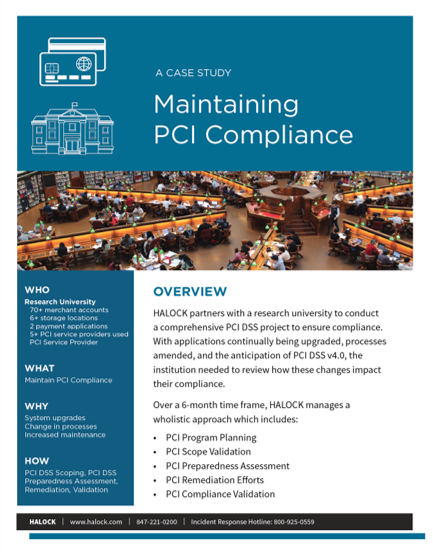
PCI REFERENCES AND ARTICLES
HALOCK’s Purpose Driven Security® philosophy and approach help you achieve and maintain PCI compliance. Our QSAs are experienced PCI security consultants who will help with all your PCI compliance assessment, remediation, validation and maintenance efforts.
“The Team was great! Thank you!”
– Transportation company
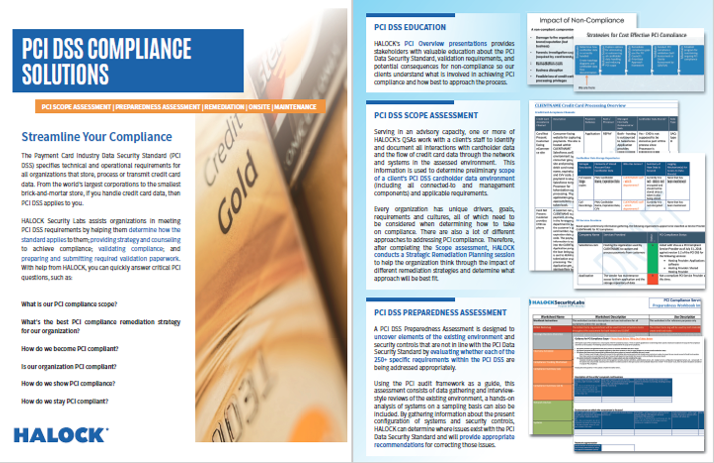
Download the PCI DSS Compliance Brochure.
“HALOCK has been a great partner to work with and have done a great job this year as well.”
– CISO, Private Research University
HALOCK is a risk management and cybersecurity firm headquartered outside of Chicago in Schaumburg, IL, and advises clients on PCI DSS compliance solutions, including reasonable information security strategies and programs for risk management, cloud security assessments, third-party risk management, incident response readiness, threat hunting or managed detection and response (MDR), ransomware risk assessment, penetration testing, sensitive data management and scanning, and more throughout the US.
Contact Us
