



Web Application Penetration Testing

Mission-Critical Web Applications Protected?
Web application penetration testing shows whether attackers can exploit weaknesses in web applications and APIs to gain unauthorized access, expose sensitive data, or manipulate business functions. HALOCK combines hands-on testing by our US-based background-checked team with application context to identify vulnerabilities, validate real attack paths, and prioritize remediation based on risk. Automated scanning can identify possible weaknesses, but it cannot fully evaluate how authentication, authorization, session handling, business logic, and application workflows interact.
HALOCK’s web app pen testing evaluates applications from the perspective of different user roles and access levels. Testers identify vulnerabilities, attempt controlled exploitation, and determine whether weaknesses can be combined to reach data or functions that should remain protected.

Why Should You Conduct Web Application Security Testing?
Custom applications are unique, which means their most important weaknesses may not appear in public vulnerability databases. Web application security testing evaluates the code, configuration, access controls, and business logic that are specific to the application.
Testing also helps validate whether the AppSec lifecycle has addressed material risk before or after deployment. Regulatory requirements can make this testing necessary for applications that handle sensitive or regulated data. PCI DSS, for example, includes application security testing requirements for applicable environments.
The objective is not simply to produce a vulnerability list. It is to determine what can actually be exploited, how far an attacker could progress, and which fixes will reduce risk most effectively.
“Very rapid turn-around. Appreciate the review.”
– Public Accounting and Consulting Firm
application penetration testing
Why Choose HALOCK for Web Application Pen Testing?
For more than three decades, HALOCK has delivered web application and pen testing across an array of industries and organizations. Our US-based application security testers use established methodologies, specialized tools, and manual testing to evaluate both common vulnerabilities and application-specific weaknesses.
HALOCK does not simply validate automated scanner results. Expert testers pursue exploitable conditions, document evidence, and connect findings to business and technical impact. Testing is conducted under controlled conditions, so your development and security teams will receive actionable results without unnecessary disruption. HALOCK is your partner in solving problems, not just identifying them.
“Extremely helpful, making sure all pen tests were completed in a small time frame.”
– Financial Services Consulting Company
Selecting web applications to test
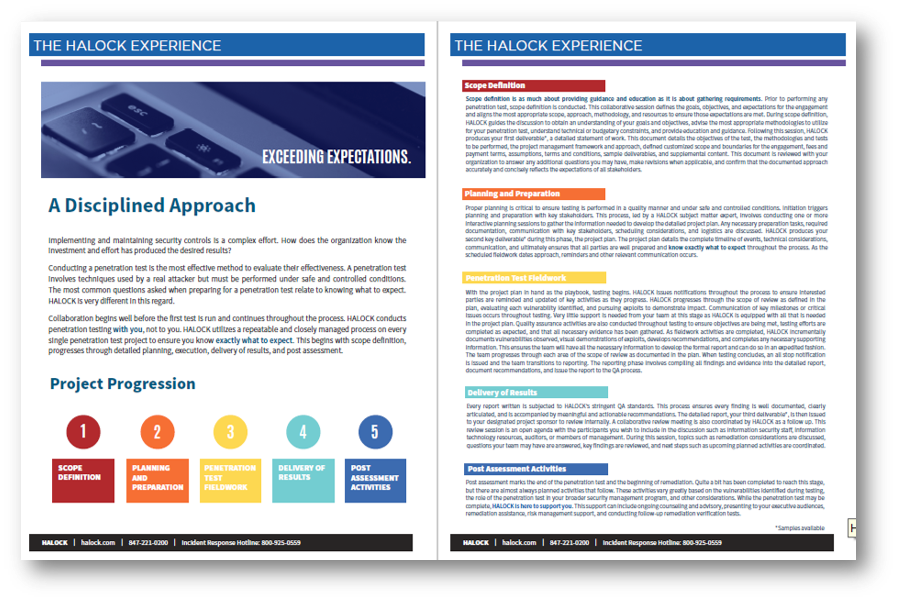
Custom-developed applications, especially those handling sensitive information or critical business functions, are strong candidates for comprehensive testing because their code and workflows are unique. Commercial applications may also warrant testing when they are heavily customized, lack a strong public testing history, or create meaningful exposure. And regulatory requirements consistently require testing web applications in data-sensitive businesses.
Your scope with HALOCK will reflect business importance, data sensitivity, application changes, regulatory requirements, and the consequences of unauthorized access. Applications with materially different roles, functions, technologies, or access models should be evaluated separately rather than treated as interchangeable.

– Global identification systems organization
Web Application Security Testing Methodology
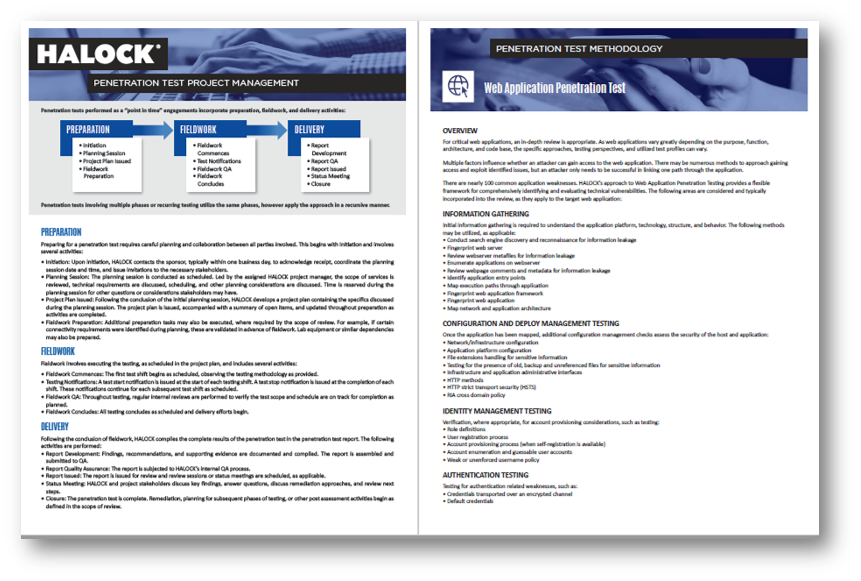
HALOCK evaluates the areas most likely to create exploitable application risk:
- Information gathering identifies technologies, entry points, functionality, and information leakage.
- Configuration and deployment testing to evaluate platform configuration and change-control weaknesses.
- Identity management reviews account provisioning, registration, and enumeration risks.
- Authentication assessment evaluates passwords, credentials, and authentication controls.
- Authorization assessment determines whether users can bypass access restrictions or escalate privileges.
- Session management evaluation can test fixation, exposed session data, replay protections, and related weaknesses.
- Data validation testing evaluates cross-site scripting, parameter tampering, SQL injection, command injection, and other input risks.
- Error-handling review identifies information exposure through errors, codes, and stack traces.
- Cryptography evaluates encryption protections and weak configurations.
- Business-logic assessment for application workflows that can be manipulated to produce unauthorized outcomes.
- Client-side evaluation for browser-side vulnerabilities, including cross-site scripting and clickjacking.
Deliverables
We will collaborate to develop a project plan to align teams and processes.
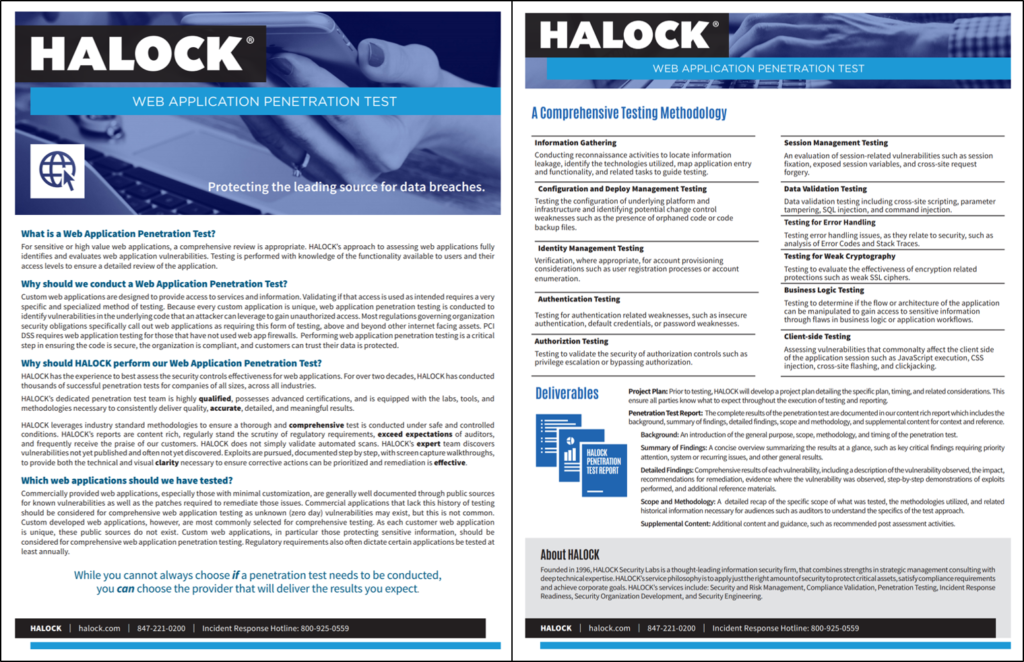
Our in-depth web application pen testing report includes:
- Background describing purpose, scope, methodology, and timing.
- Summary of findings identifying critical and recurring issues.
- Scope and methodology explaining what was tested and how.
- Detailed findings documenting validated vulnerabilities, impact, evidence, exploitation steps, and remediation recommendations.
- Supplemental guidance for appropriate post-assessment actions.
We work together to provide a practical view of application exposure that helps development, security, compliance, and leadership teams prioritize fixes based on demonstrated risk. And to manage the ongoing and accelerating challenge of managing web apps, the HALOCK Penetration Testing Programregularly assesses your safeguards throughout the year for a proactive security approach.

”Thank you for all your help.”
-Professional Association
KEEPING YOU INFORMED ON CYBERSECURITY NEWS, BREACHES, and TRENDS
HALOCK, a trusted web application penetration testing company headquartered in Schaumburg, IL, near Chicago, advises clients on reasonable information security strategies, risk assessments, third-party risk management (TPRM), penetration testing, security management, architecture reviews, and HIPAA, Privacy, & PCI compliance throughout the US.
Contact Us
