



Cloud Security Assessment

Limited Special: Cloud Security Bundle
What Are Your Cloud Security Underlying Risks?
When it comes to cloud security, one of the biggest threats isn’t a shadowy hacker—it’s access-related vulnerabilities. In fact, most cloud breaches stem from things like weak credentials, misconfigured permissions, or lack of visibility into who can access what.
And here’s the kicker: most public cloud environments are storing some form of sensitive data—yet many organizations haven’t evaluated the security of their cloud service since they first signed the contract.
So how do you get ahead of the risks for cloud?
HALOCK Security Labs offers a Cloud Security Assessment. It addresses the following questions:
- How do you understand and prioritize threats in your environment?
- How do you ensure business continuity in the face of a potential breach?
- How can you grow your business while still maintaining strong cloud security?
Cloud Covered
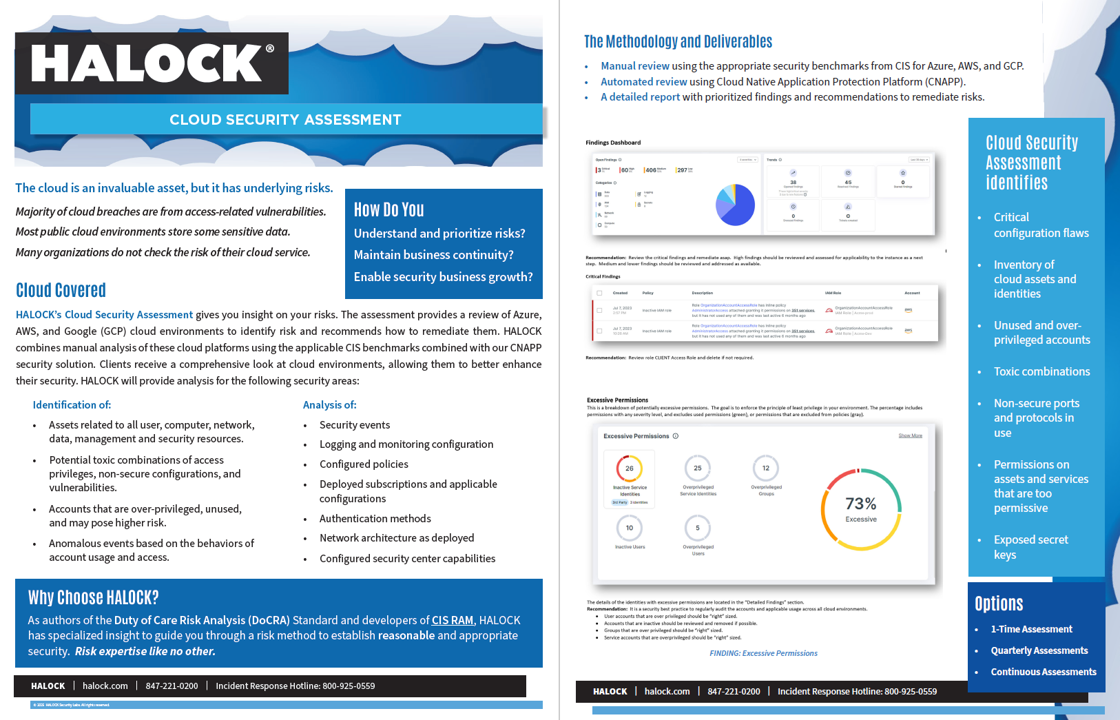
Want a clear picture of where your cloud security really stands? HALOCK’s Cloud Security Assessment is designed to give you just that.
We dive deep into your Azure, AWS, and Google Cloud (GCP) environments to uncover security risks and provide actionable recommendations to fix them. Our assessment blends manual analysis using CIS Benchmarks with the power of a Cloud-Native Application Protection Platform (CNAPP)—giving you a well-rounded, detailed view of your cloud landscape.
You’ll walk away with a full understanding of your cloud environment, along with expert guidance on how to enhance your cloud security posture. Here’s what we analyze:
We identify:
- Assets tied to users, computers, networks, data, management, and security tools
- Potential toxic combinations—like risky permissions, insecure configurations, and existing vulnerabilities
- Accounts that are over-privileged, unused, or simply pose unnecessary risk
- Anomalous behavior based on how accounts are being used and accessed
We analyze:
- Key security events across your cloud platforms
- How logging and monitoring are configured
- Active security policies and how they’re applied
- Subscriptions and the settings that come with them
- Authentication methods in use
- Your current network architecture
- Cloud-native security center settings and capabilities
If you’re looking to strengthen your cloud security strategy, this is where it starts.
The Methodology and Deliverables
Our Cloud Security Assessment uses a powerful combination of manual expertise and automated tools to give you a full-spectrum view of your risks.
Here’s how we do it:
- Manual review of your Azure, AWS, and GCP environments, using the appropriate CIS Security Benchmarks to ensure best practices are met
- Automated analysis using advanced CNAPP (Cloud-Native Application Protection Platform) tools to catch what automated scans alone might miss
- A detailed report with clear, prioritized findings and step-by-step recommendations to help you fix security gaps and reduce risk
It’s not just about identifying issues—it’s about giving you the insight and roadmap to build stronger cloud security moving forward.

What Does the Cloud Security Assessment Uncover?
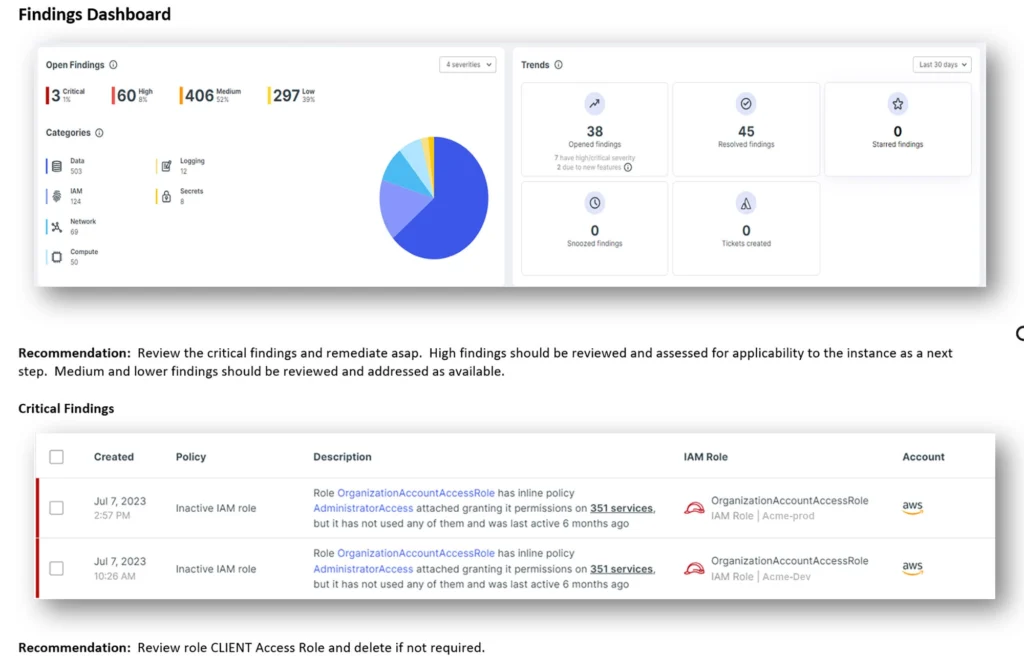
Our cloud security assessment is designed to surface the issues that put your organization at risk—before they become costly problems.
Here’s what we help you uncover:
Critical configuration flaws that could leave you vulnerable
A full inventory of cloud assets and identities, so nothing slips through the cracks
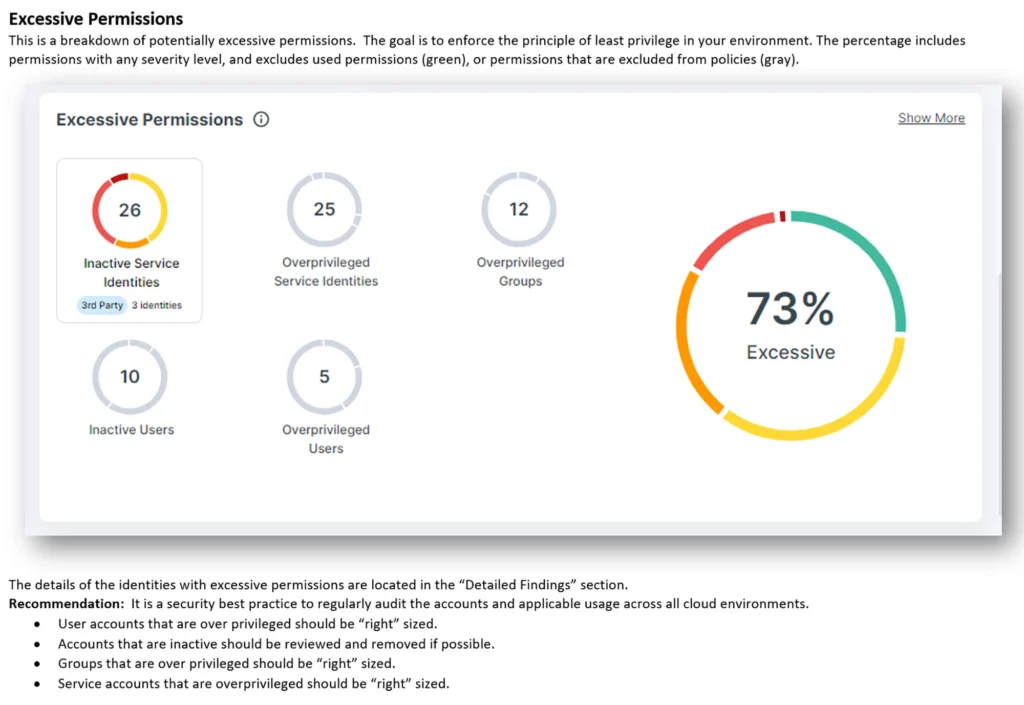
Unused or over-privileged accounts that could be exploited
Dangerous toxic combinations of access, permissions, and misconfigurations
Non-secure ports and protocols that should be locked down
Overly permissive access controls on assets and services
Exposed secret keys that should be safeguarded
With this level of insight, you can take real, targeted action to improve your cloud security posture fast.
Cloud Security Service Options That Fit Your Needs
Every organization is different, which is why we offer flexible options to match your goals and pace:
One-Time Assessment – A deep dive to understand your current risks and priorities
Quarterly Assessment Services – Regular reviews to stay on top of changes and maintain security
Continuous Assessment Services – Ongoing visibility and response to evolving cloud risks
No matter where you are in your cloud security journey, we’re here to help you move forward with confidence.
Why Choose HALOCK for Cloud Security?
When it comes to cloud security, you want a partner who knows more than just best practices—you want one who helped shape them.
HALOCK is the author of the DoCRA Standard and the developer of CIS RAM, giving us unique insight into how to balance risk, compliance, and practical, reasonable security. We help organizations like yours apply smart, risk-based strategies to secure their cloud environments.
Based in Schaumburg, IL, just outside of Chicago, HALOCK is a trusted cybersecurity and risk management consulting firm supporting clients across the U.S. with deep experience in building tailored cloud security programs.
Let’s Talk About Your Cloud Security Assessment
Want to know what it’ll take to secure your cloud environment? Let’s help you scope and quote your Cloud Security Assessment—no pressure, just straight answers.
Review Your Cloud Security Posture
Cloud Security & Risks FAQs
What are the Top Cloud Cybersecurity Threats and Risks?
How can Organizations help Safeguard against these Risks?
Misconfiguration & inadequate change control
One of the most common cloud security risks is misconfiguration of cloud resources (e.g., open storage buckets, default credentials, overly-broad permissions) and weak change control.
Why: Many cloud breaches stem from access-related vulnerabilities such as mis-set permissions or weak credentials. One report indicates 84% of organizations had at least one neglected public-facing asset in their cloud environment. The dynamic nature of cloud and multi-cloud use means resources spin up quickly and may not be properly governed.
If these vulnerabilities are present, the organization may expose data, increase its attack surface, and suffer reputational, financial, or compliance losses.
Safeguard: Implement automation for configuration checks, apply least privilege, monitor for drift in infrastructure-as-code, and ensure strong change-management processes.
Weak Identity & Access Management (IAM), credential theft/account hijacking
Why: Identity and permissions issues are the primary causes of cloud-related breaches. A 2024 study stated 99% of organizations experienced a cloud breach, citing identities/permissions as a primary cause. Also, of 209 million identities in Microsoft cloud environments, only 2% of permissions were actually used, yet 50% posed a high risk. With multiple cloud providers and workload identities, IAM complexity grows and increases exposure.
Because compromised credentials or unmanaged permissions can lead to lateral movement, privilege escalation, and full environment compromise.
Safeguard: Enforce strong multi-factor authentication (MFA), audit roles/permissions, remove unused accounts, segment high-privilege access, and maintain visibility of all identities.
Insecure Interfaces / APIs
Publicly accessible, exposed, or insecure cloud APIs/interfaces (management/API endpoints) are a top security risk.
Why: As more organizations adopt cloud services, containers, micro-services, serverless, etc., the attack surface is expanded through APIs. Authentication, authorization, and monitoring of APIs need to be secured. Misconfigured APIs or insecure management endpoints can allow attackers to exploit the connections, automation, and/or data flows.
Attackers can abuse APIs to access sensitive data, modify configurations, or disrupt service.
Safeguard: Design APIs as first-class security objects. Enforce strong authentication, input validation, monitoring for anomalous API calls, least privilege, and allow-listing to only necessary API endpoints.
Data Breach / Data Loss
Unauthorized access to or loss of data in the cloud is a primary risk.
Why: Cloud environments are often targeted for data due to the sensitivity of the data often present there, and deployment cycles typically outpace security strategy and implementation. As per a 2022 report cited by SC Magazine, “almost two-thirds (65%) of organizations” experienced a cloud security breach in the previous 12 months.
Data breaches or loss can result in regulatory fines, reputational damage, loss of customer trust, and potential business disruption.
Safeguard: Encrypt data-at-rest and in-transit, apply data-loss-prevention (DLP) software, enable backups, maintain clear data-governance policies (including geo-location of data), and monitor for anomalous downloads/exfiltration.
Lack of Visibility, Monitoring & Shadow IT
Lack of visibility into cloud assets, use, and risk, including “Shadow IT,” is a high risk.
Why: Organizations have a weak understanding of their overall cloud estate: cloud assets (services and identities) and service usage patterns. This can be worsened by Shadow IT – cloud assets provisioned by employees (dev-teams, etc) without central visibility/mgmt. Further, a skills gap within orgs makes detection harder.
Lack of visibility and monitoring can allow threats to go unnoticed, misconfigurations to be uncorrected, and attacks to go undetected/ramp up.
Safeguard: Maintain cloud assets/service inventory, enable unified logging/monitoring across cloud environments, alert on suspicious activity and enforce governance and policy on cloud service sprawl.
Shared Technology / Multi-Tenant Risks & Supply-Chain Issues
Risks from shared infrastructure, multi-tenant environments, and upstream cloud-supply-chain dependencies are more acute.
Why: Cloud platform/service models (IaaS, PaaS, SaaS) typically involve shared infrastructure or services between customers or applications, bringing to light vendor/third-party risk and multi-tenant attack vectors. On top of this, with increased cloud adoption, the supply chain (third-party libraries, APIs, cloud services, etc.) becomes another vector of attack.
If a vulnerability is discovered in a shared component or at the cloud provider, it may impact many of their customers.
Safeguard: Vet cloud providers and third-party vendors thoroughly, actively monitor dependencies and other risks, ensure patches/updates are regularly applied, segment and isolate workloads, and factor in supply-chain risk into the threat model.
Denial of Service, Zero-Day & Emerging Threats
Zero-day, emerging threats such as cloud-native denial of service (DoS), unknown vulnerabilities, and new attack vectors are valid cloud risks.
Why: Every year new cloud-related attack techniques are discovered. Furthermore, a high proportion of incidents continue to be associated with known control failures and well-documented/motivated vectors. With the rapidly increasing cloud adoption rate, there is a higher number of targets, making the cloud attack surface more dynamic, which may also result in more misconfigurations.
Zero-day/Unknown/Novel threats can result in service disruptions, data integrity issues, or abuse of vulnerabilities which are not yet publicly known and for which no mitigation yet exists.
Safeguard: Ensure good patching practices, implement DDoS protection, stay up-to-date on threat intelligence, and build cloud-resilience into infrastructure, workloads and maintain Incident response plans (IRPs).
