Surviving three decades in business is no small achievement, and it’s no secret that business survival rates decline substantially over time. In fact, according to the U.S. Bureau of Labor Statistics, only 13.2% of private-sector business establishments opened in 1995 were still operating 30 years later. That kind of longevity doesn’t happen by accident. Such enduring success reflects a rare ability to adapt, innovate, and consistently put customers first through three decades of change.
30 Years for HALOCK Security Labs
HALOCK Security Labs was founded in 1996, and after three decades, we remain true to the principles that have guided us since the beginning. Our focus on continuously innovating and developing security strategies that align with business priorities has carried us to where we are today.
In 1996, cybersecurity was a fraction of what it is today. Most organizations operated within on-premises networks with company-owned PCs and internal servers. The internet was still emerging, malware traveled through floppy disks and shared files, and the typical attacker was a hobbyist, a researcher, or a member of a loosely organized group pursuing curiosity more than profit. It was a different world.
The Emergence of DoCRA
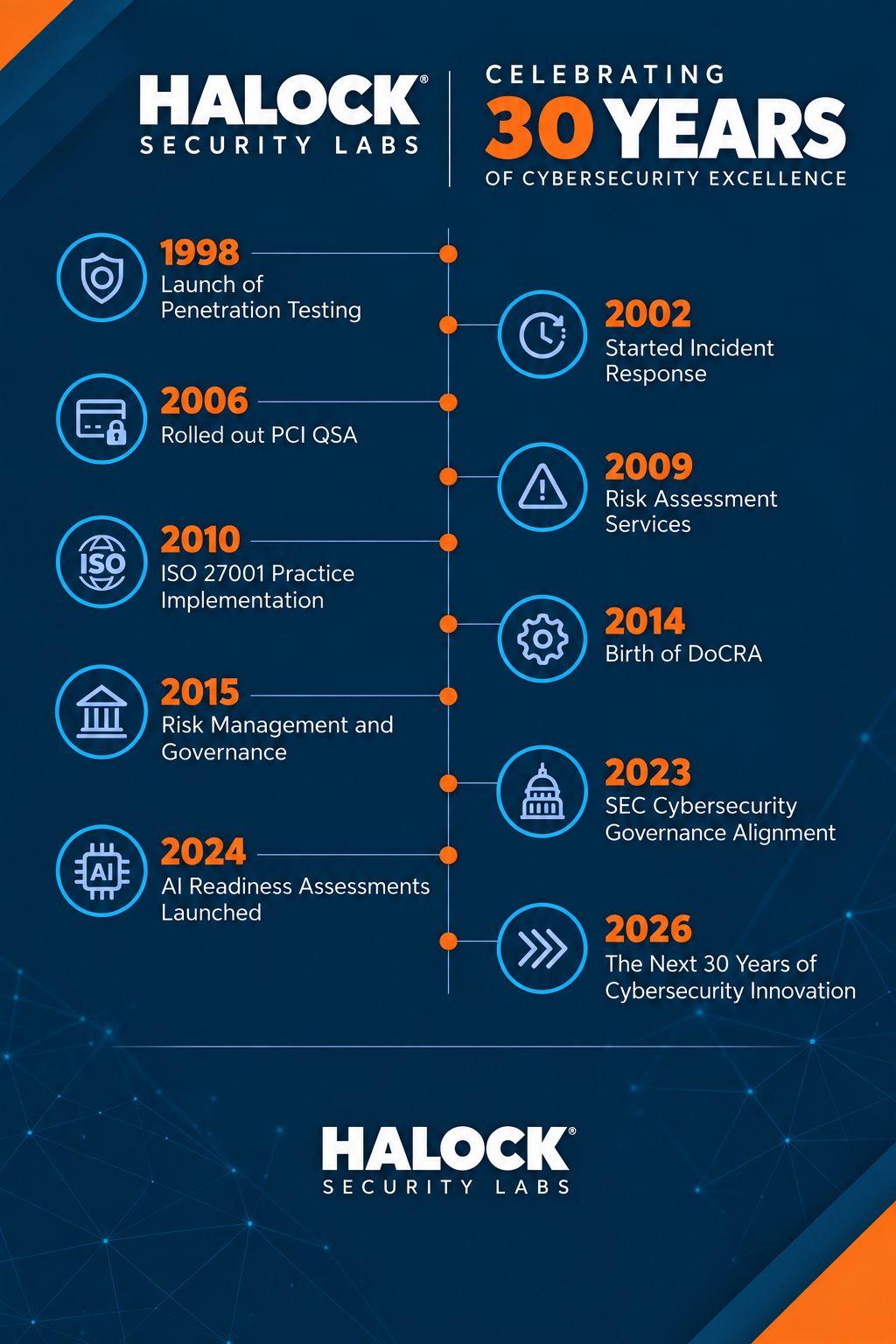
As the attack surface expanded over the years and attackers became more adept and organized, it became apparent that a business couldn’t spend its way to eliminating all risk. In 2014, HALOCK began applying DoCRA (Duty of Care Risk Analysis), a methodology that weighs the potential harm of a security incident against the burden of implementing safeguards. This more meaningful standard of “reasonable security” is one that is proportionate to the organization’s size, complexity, and risk tolerance, and it leads to security decisions that are defensible, justifiable, and grounded in business reality.
Other Milestones for HALOCK Security Labs
Expanding the use of DoCRA to help clients determine reasonable and defensible security safeguards is just one of the milestones that has defined HALOCK’s three decades in the industry. In 1998, the company was among the first to offer penetration testing commercially, at a time when the practice was still taking shape. Six years later, HALOCK began offering incident response readiness and breach response services. Additional milestones since then include:
- 2017: HALOCK pioneers the Proven Governance System, providing organizations with a structured framework for aligning cybersecurity with business objectives.
- 2018: HALOCK creates a strategic alliance with the Center for Internet Security (CIS) and helps author the CIS Risk Assessment Method (CIS RAM), creating a practical approach for measuring and managing cybersecurity risk.
- 2020: HALOCK expands its influence on the national scene through its contribution to the Sedona Conference’s Reasonable Security Test, which helped establish a more consistent framework for evaluating security practices, including the reasonableness of safeguards rather than compliance alone. HALOCK’s Chris Cronin served as a dialogue leader at the conference.
- 2021: HALOCK launches Reasonable Risk to give organizations a defensible way to balance security obligations with practical business needs. That same year, DoCRA appears in its first regulatory consent order, signaling its growing influence in legal and compliance circles.
- 2022: Reasonable Risk becomes available to select clients, providing a methodology to evaluate cybersecurity risks and document reasonable security decisions in real-world environments.
- 2025: Reasonable Risk is launched at RSA Conference 2025, bringing its risk assessment approach to a broader cybersecurity audience.
HALOCK’s Leadership Through Cybersecurity Milestones
Cybersecurity is a constantly moving target. Threats, technologies, regulations, and attacker tactics evolve faster than most organizations can adapt on their own. What was considered strong security a decade ago may be inadequate today. Throughout these shifts, HALOCK has been present for many industry-changing milestones.
Cybersecurity Moves Beyond Prevention
Lockheed Martin’s introduction of the Cyber Kill Chain in 2011 signaled a fundamental shift in security thinking. As traditional perimeter defenses continued to fall short against advanced persistent threats, the framework gave security teams a new model for understanding attacker behavior. This moved the needle from reactive prevention toward proactive, intelligence-driven defense.
Cybersecurity Becomes a Risk and Resilience Issue
The widespread Shamoon malware attack in 2012 demonstrated how cyberattacks could disrupt business operations on a massive scale. This prompted greater government and industry collaboration, which resulted in Executive Order 13636 in 2013 and the introduction of the NIST Cybersecurity Framework in 2014. During this same period, HALOCK was advancing its Duty of Care Risk Analysis (DoCRA) approach through client engagements and litigation support.
Breaches and Cyber Insurance Expand the Definition of Readiness
The country went through a period in which attacks on some of the biggest corporate names, including Home Depot and Target, demonstrated that cybersecurity was about more than the implementation of tools. It was becoming something every business had to prepare for, manage, and demonstrate.
Ransomware Pushes Cyber Risk Toward Executive Leadership
The WannaCry and NotPetya outbreaks marked a major turning point in 2017. The billions of dollars in damage forced cybersecurity onto the agendas of executive leadership and boards. Organizations responded by increasing investment in threat detection, incident response, and coordinated recovery efforts. That same year, as cybersecurity was clearly recognized as a business risk, HALOCK introduced its Proven Governance System.
AI Compresses the Attack Cycle
Today we find ourselves in the midst of another instrumental shift in cybersecurity, as AI is now accelerating every phase of the attack cycle, from reconnaissance through persistence, leaving defenders less time to respond than ever before. HALOCK’s response is Preemptive cybersecurity, emphasizing stronger AI governance and earlier intervention before attacks gain momentum. The timeline reaches its current chapter with the 2025 launch of Reasonable Risk.
We Look Forward to 30 More
Throughout every phase of cybersecurity over the past 30 years, HALOCK Security Labs has been there, providing leadership, innovation, research, and strategic initiatives to both our customers and the cybersecurity community at large. At HALOCK, we’re just getting started, as we plan to guide organizations through whatever the next 30 years of cybersecurity brings.