



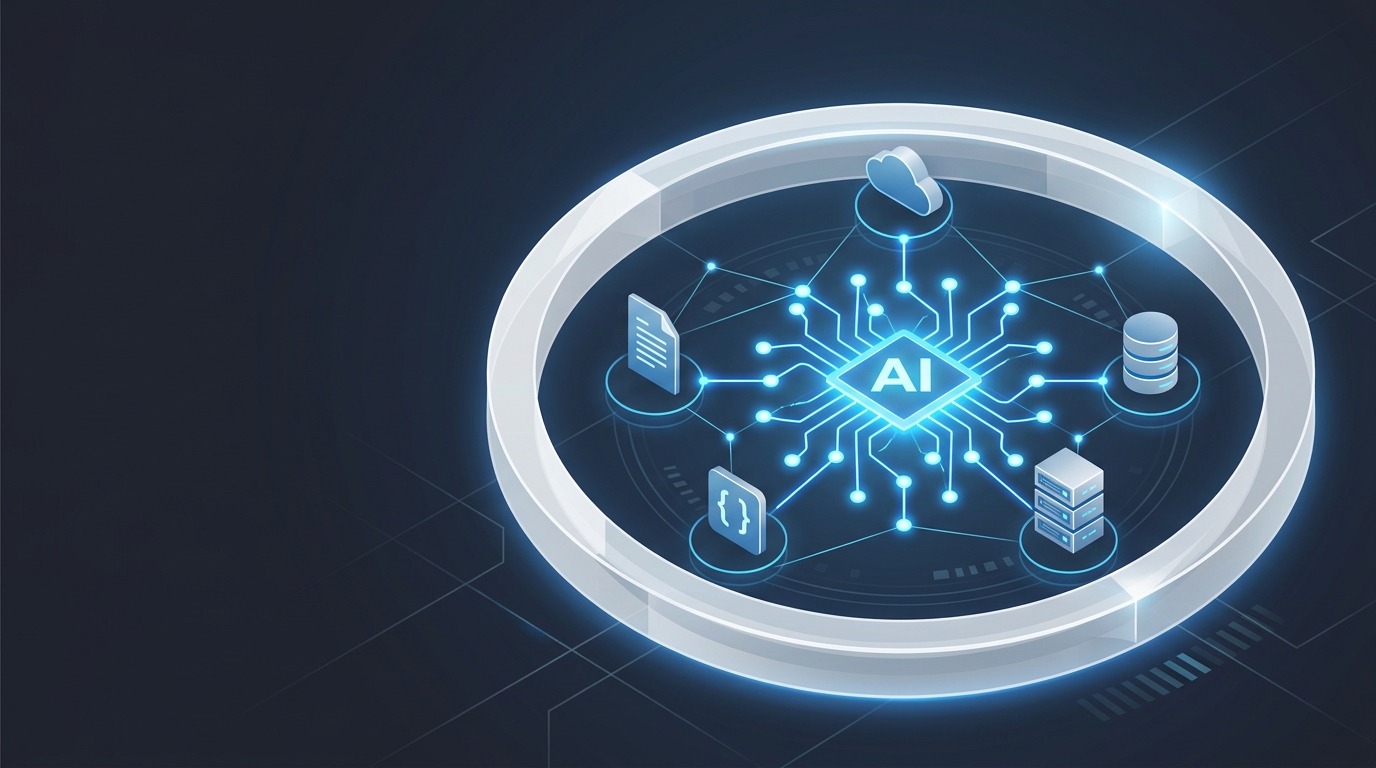
Have you noticed lately that AI is no longer confined to a chatbot interface? In the same way that the internet became embedded into everything as the technology matured, AI is increasingly connected to all sorts of things, including:
- Enterprise applications
- Sensitive data repositories
- APIs and productivity tools
- Cloud services
- Infrastructure platforms
- Essential business processes
Organizations rolling AI into production often ask, “Is this model secure?” Unfortunately, that’s a dated question that doesn’t go far enough. The relevant question today is: “Can we secure the entire environment the AI operates in?”
The Two Sides of AI
The growing presence of AI helps employees summarize documents, analyze data, automate routine work, and make decisions faster. However, the growing connectivity and influence of AI is quickly changing the security equation.
For an employee interacting with an AI agent, the risk is not limited to whether the model produces an inaccurate answer. The concern is whether the entire system can be influenced to expose data, misuse permissions, take unauthorized action, or create a path for an attacker to move through connected services. AI readiness requires knowing not only what your systems are designed to do, but also how they respond when an unauthorized user or attacker attempts to manipulate them.
AI Expands the Attack Surface
Historically, applications operated within well-defined boundaries. Security teams could assess web applications, APIs, networks, and infrastructure separately. AI changes all of that by functioning as a bridge between many previously distinct systems.
For example, an AI assistant may have access to corporate documents, email, collaboration platforms, customer records, internal knowledge bases, cloud resources, and third-party services. AI agents can also execute actions such as updating records, initiating workflows, generating communications, or interacting with business applications.
Preparing for AI Readiness
Are you ready for that challenge? AI readiness requires knowing what could happen if a user asks the assistant to summarize a sensitive project folder, or if the assistant retrieves content from a document containing malicious instructions designed to manipulate its behavior. These weak points can become visible using a comprehensive AI risk assessment. Strong AI risk management requires understanding not only where vulnerabilities exist, but also how those vulnerabilities could be leveraged to impact business confidentiality and regulatory compliance.
By pairing traditional security testing with AI-focused evaluation, organizations can see whether sensitive data might be exposed, altered, or misused through AI-driven workflows. For teams adopting Microsoft’s AI capabilities, a Microsoft 365 Copilot security assessment offers a clear view of real-world risk by examining how permissions are set, what data users can reach, and how Copilot handles that information in everyday tasks. A broader Copilot security assessment adds confidence by validating how AI features behave across different scenarios and data sets.
HALOCK Can Make Your Business AI Ready
At HALOCK Security Labs, the goal isn’t to slow down AI adoption. It’s to make sure innovation doesn’t outpace the safeguards that keep your data, users, and business protected. Once we understand your business and your AI vision, our penetration testing team gets to work testing the models themselves, the applications built around them, the connected infrastructure, and the systems that AI interacts with.
The AI revolution is here. Let’s make sure it’s safe.
