



Risk Management Program
Reach and Maintain Acceptable Risk
Formalize Governance. Operationalize Cybersecurity. Manage Risk with Confidence.
A structured Risk Management Program enables your organization to identify, assess, treat, monitor, and govern cybersecurity risk in a measurable and defensible way. Regulators, insurers, boards of directors, and executive leadership now expect organizations to risk manage cybersecurity with the same discipline applied to financial, operational, and strategic risk.
Risk management is not a one-time event—it’s a continuous process. Cyber threats don’t operate on a schedule, and risk can shift from manageable to critical in the blink of an eye. Whether you’re facing routine business operations or a sudden cybersecurity breach, your ability to manage your organization’s risk effectively can determine the long-term health of your organization. Understand your security and risk profile for your operations, especially with the growing use of AI (artificial intelligence).
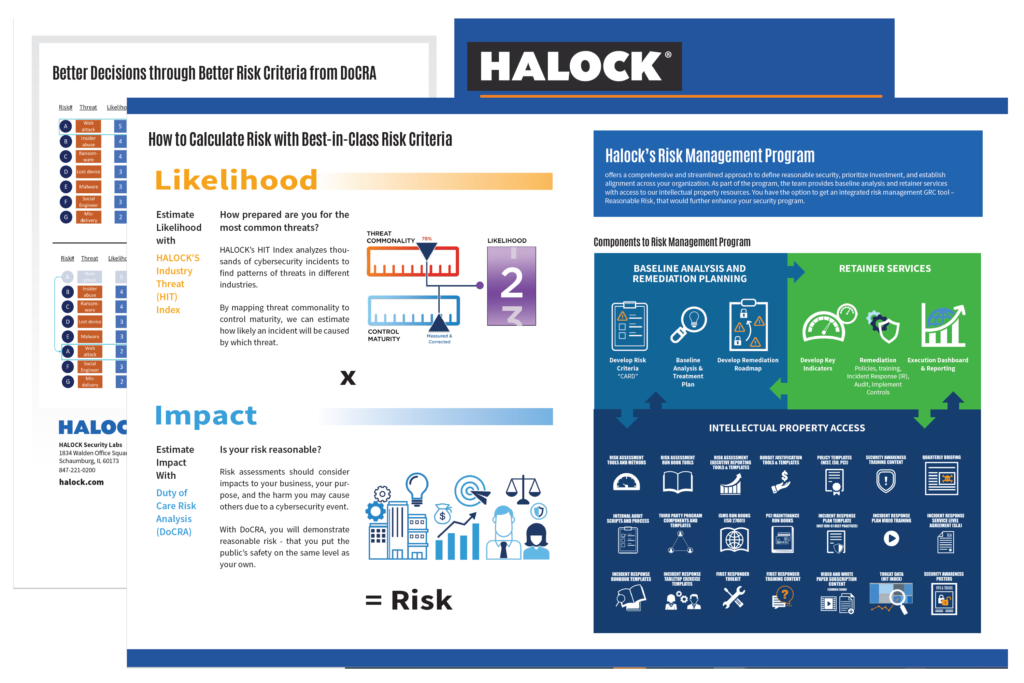
Why choose HALOCK for your Risk Management Program?
HALOCK Security Labs formalizes risk management and governance through advisory and program management, providing a clear roadmap toward reasonable cybersecurity and equipped experts help you implement controls and measure risk reduction so your executives can help manage cybersecurity. After all, you are now expected to manage cybersecurity the way you manage every other part of your business. HALOCK helps you build, mature, and sustain a program that makes cybersecurity governance operational — not theoretical.
HALOCK’s Risk Management Program is structured to align with recognized frameworks and regulatory expectations while remaining operationally practical. Our approach includes:
- Governance & Executive Oversight – Establish clear roles, leadership accountability, reporting cadence, and board visibility.
- Risk Identification & Assessment – Identify assets, threats, vulnerabilities, and business impact to define your risk profile.
- Prioritized Risk Treatment Roadmap – Create a roadmap toward reasonable cybersecurity that balances risk reduction with business realities.
- Control Implementation Support – Translate risk findings into implemented, operational safeguards.
- Risk Measurement & Reporting – Measure risk reduction over time so executives can make informed, defensible decisions.
Why a Formal Risk Management Program Matters
Without a structured Risk Management Program, cybersecurity efforts tend to become reactive, inconsistent, and difficult to defend under regulatory scrutiny. Organizations often struggle to demonstrate alignment, measure progress, or clearly communicate risk to leadership.
With a formal Risk Management Program in place, cybersecurity becomes governed, measured, and strategically managed. Your organization can demonstrate regulatory alignment, improve audit readiness, strengthen cyber insurance positioning, provide executives with measurable risk insight, and confidently risk manage cybersecurity as an ongoing business discipline — not a periodic compliance exercise.
Risk Management Built for Executive Accountability
Modern regulatory expectations require active leadership oversight of cybersecurity risk. A mature Risk Management Program provides documented governance structures, clear risk visibility, measurable control effectiveness, and defensible reporting that supports informed decision-making.
Rather than relying on informal updates or technical summaries, executives gain structured insight into risk reduction efforts and program maturity. Cybersecurity is managed with the same rigor, accountability, and oversight applied to every other core business function.
How do you risk manage a complex environment where stakeholders have conflicting priorities?
Introducing Duty of Care Risk Analysis (DoCRA)
HALOCK’s Risk Management Program, grounded in the principles of DoCRA, provides a balanced and defensible way to manage cyber risk. DoCRA (Duty of Care Risk Analysis) is a standards-based methodology that helps organizations assess and justify their cybersecurity controls in a way that is legally defensible, ethically sound, and operationally practical.
With DoCRA, your organization can:
Prioritize security investments based on business impact
Align controls with compliance mandates (HIPAA, PCI DSS, CCPA, etc.)
Address the needs of all stakeholders—from executives and legal teams to customers and regulators
Justify that your risk decisions are reasonable and acceptable
Avoid over- or under-securing your environment
Strengthen your position for cyber insurance eligibility and claims
Demonstrate ongoing risk management to auditors and board members

Frequently Asked Questions (FAQ) on Reasonable Security
Why is “Reasonable” Security Important?
“Reasonable security” language is found in most state and federal privacy laws, and regulators have ruled that you must show you took “reasonable” steps to protect sensitive information.
Reasonable security does not mean perfect security, but rather security that makes sense based on your risks and resources.
Organizations with reasonable security:
- Have a better chance of avoiding regulatory action after a breach
- Are better positioned during litigation and investigations
- Have more support from cyber insurance carriers and adjusters
- Instill more confidence with clients, partners, and stakeholders
What Laws and Regulations Reference “Reasonable Security”?
In the United States, a variety of state and federal laws and regulations require organizations to have “reasonable security practices and procedures.” These include, but are not limited to:
“(3) Grants the business rights to take reasonable and appropriate steps to help ensure that the third party, service provider, or contractor uses the personal information transferred in a manner consistent with the business’ obligations under this title.”
“(5) Grants the business the right, upon notice, including under paragraph (4), to take reasonable and appropriate steps to stop and remediate unauthorized use of personal information.”
“(e) A business that collects a consumer’s personal information shall implement reasonable security procedures and practices appropriate to the nature of the personal information to protect the personal information from unauthorized or illegal access, destruction, use, modification, or disclosure in accordance with Section 1798.81.5.”
“(b) A business that owns, licenses, or maintains personal information about a California resident shall implement and maintain reasonable security procedures and practices appropriate to the nature of the information, to protect the personal information from unauthorized access, destruction, use, modification, or disclosure.
(c) A business that discloses personal information about a California resident pursuant to a contract with a nonaffiliated third party that is not subject to subdivision (b) shall require by contract that the third party implement and maintain reasonable security procedures and practices appropriate to the nature of the information, to protect the personal information from unauthorized access, destruction, use, modification, or disclosure.”
“requiring that companies develop, implement, and maintain reasonable safeguards to protect the security, confidentiality, and integrity of the private information”
(a) A data collector that owns or licenses, or maintains or stores but does not own or license, records that contain personal information concerning an Illinois resident shall implement and maintain reasonable security measures to protect those records from unauthorized access, acquisition, destruction, use, modification, or disclosure.
(b) A contract for the disclosure of personal information concerning an Illinois resident that is maintained by a data collector must include a provision requiring the person to whom the information is disclosed to implement and maintain reasonable security measures to protect those records from unauthorized access, acquisition, destruction, use, modification, or disclosure.
“(4) Reasonable monitoring of systems, for unauthorized use of or access to personal information;”
Controllers must “Use reasonable safeguards to secure personal data.”
“the Gramm-Leach-Bliley Act, sets forth standards for developing, implementing, and maintaining reasonable administrative, technical, and physical safeguards to protect the security, confidentiality, and integrity of customer information.”
“What does a reasonable information security program look like?”
“every reasonable step must be taken to ensure that personal data that are inaccurate, having regard to the purposes for which they are processed, are erased or rectified without delay (‘accuracy’);”
How Do You Demonstrate Reasonable Security?
The most effective way is through a documented, risk-based assessment process that allows you to show how your organization identifies, prioritizes, and mitigates risks.
A legally defensible risk assessment provides a fact-based argument that your actions were prudent, informed, and proportionate.
Key elements include:
- Risk identification: What data, systems, and processes are impacted?
- Threat and vulnerability analysis: What risks are credible and foreseeable?
- Impact assessment: What could cause harm to customers, partners, or operations?
- Control evaluation: What safeguards are reasonable under current conditions?
- Documentation: Written records of your findings, decisions, and mitigations.
Security and legal frameworks such as NIST SP 800-30, ISO 27005, CIS Controls, and DoCRA (Duty of Care Risk Analysis) can help define and prove what “reasonable” looks like in practice.
Is Reasonable Security the Same as Compliance?
No. Compliance meets minimum standards, but reasonable security shows you went above and beyond with due care.
What Is the Duty of Care Risk Analysis (DoCRA)?
The Duty of Care Risk Analysis (DoCRA) standard is an approach to establish and document reasonable security for an organization. It states that reasonable security is:
“Security that balances the interests of the organization with the interests of others who may be harmed if security fails.”
DoCRA helps organizations to review and justify risk decisions, not only from a compliance point of view but also with respect to fairness, proportionality, and legal defensibility. In essence, it considers an organization’s mission, objectives, and obligations. It effectively bridges security, business, and legal aspects in one defensible framework.
What is a Risk Management Program in cybersecurity?
A Risk Management Program in cybersecurity is a formal, ongoing process for identifying, assessing, prioritizing, mitigating, and monitoring cybersecurity risks. It ensures leadership oversight, documented governance, measurable control implementation, and continuous risk reduction.
Why is a Risk Management Program important?
A Risk Management Program is important because regulators, insurers, and boards expect organizations to formally manage cybersecurity risk. Without a structured program, risk management becomes reactive and difficult to defend during audits, regulatory reviews, or litigation.
How does a Risk Management Program help executive?
A Risk Management Program provides executives with measurable insight into cybersecurity risk, defined governance processes, and documented risk reduction efforts. This enables informed decision-making and demonstrates active oversight.
What is the difference between risk management and compliance?
Compliance focuses on meeting specific regulatory requirements. A Risk Management Program goes further by continuously identifying and reducing risk — even beyond minimum compliance thresholds.
How do you measure risk reduction?
Risk reduction is measured through documented control implementation, risk scoring methodologies, maturity tracking, and ongoing reporting metrics. A mature Risk Management Program establishes clear benchmarks and tracks improvement over time.
When should an organization implement a Risk Management Program?
Organizations should implement a Risk Management Program when:
Regulatory oversight increases
Cyber insurance requirements tighten
Executive leadership demands measurable reporting
Rapid growth introduces new risk exposure
Existing cybersecurity efforts lack structure
The earlier a formal program is established, the more defensible and cost-effective it becomes.
How Does HALOCK Help Organizations Demonstrate Reasonable Security?
HALOCK offers cybersecurity assessments that are risk-based, legally defensible, and aligned with the Duty of Care Risk Analysis (DoCRA) standard.

Learn how Duty of Care Risk Analysis (DoCRA) can help you achieve reasonable security:
What is Duty of Care Risk Analysis (DoCRA) for Cybersecurity?
What is Duty of Care Risk Analysis (DoCRA) for General Counsel?
What is Duty of Care Risk Analysis (DoCRA) for Regulators?
What is Duty of Care Risk Analysis (DoCRA) for Auditors?
What is Duty of Care Risk Analysis (DoCRA) for Executives?
What is Duty of Care Risk Analysis (DoCRA) for Risk Managers?
