



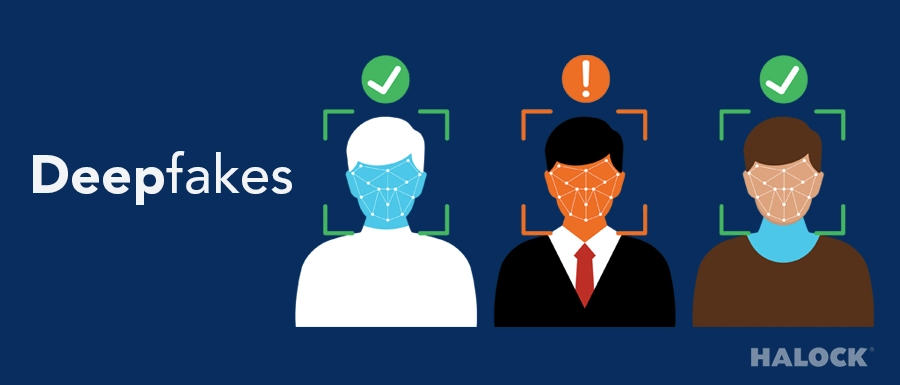
Imagine your company’s CEO invites you and other leaders within your organization to a ZOOM meeting. The meeting begins with light conversation as the CEO warmly greets each participant with a smile. He asks how your son’s little league game went the other day, while the CFO tells you she loved meeting your wife at the dinner party last week. The CEO informs the team about a sudden acquisition that has been negotiated, which requires a series of wire transfers. The CFO then asks you to initiate the transfer, and the meeting is adjourned. Days later, you find out that the real CEO and CFO never spoke to you. Their presence was AI-generated. It was all a deepfake, and unfortunately, the money is gone.
Deepfake Attacks are Very Real
Such an instance happened to an engineering firm back in January of 2024. That incident cost the company $25 million. In this new era of AI, seeing is no longer believing as was illustrated in 2023 when an AI-generated picture of an explosion occurring within the Pentagon spread across social media. The image caused a brief stock market to drop before being revealed as fake. Don’t believe everything you hear either, as luxury car manufacturer, Ferrari, discovered when a company executive nearly fell victim to a deepfake conversation featuring an AI-generated voice impersonating their CEO.
The art of the deepfake is becoming all too common today. According to a 2025 Gartner survey of 302 cybersecurity leaders, 43% reported experiencing at least one audio deepfake incident, and 37% encountered deepfake video calls. Gartner reports that AI agents are rapidly improving their ability to use deepfake voices, making social engineering attacks far more convincing. As deepfake audio technologies advance, these agents can more easily trick victims and bypass traditional verification processes.

How are Deepfakes so Convincing?
It’s the little details that make a deepfake so convincing. Modern attackers don’t rely solely on synthetic video or audio. Instead, they blend AI with open-source intelligence (OSINT) gathered from your own digital footprint. An email that references your spouse or your child’s little league game can easily be harvested from your own social media posts. That voicemail or live call from your CEO asking you to authorize a wire transfer sounds legitimate because the attacker trained an AI model on hours of the CEO’s recorded voice from conference talks, podcasts, or YouTube presentations. Deepfakes exploit not only what AI can generate, but also what we willingly share online, turning personal and organizational information into weapons of trust.

What Tools Do You Need Protect Yourself Against Deepfakes?
There is no doubt that AI is greatly accelerating the sophistication of social engineering and phishing attacks. The good news is that there are companies like HALOCK Security Labs providing services to keep you one step ahead of getting duped by these dubious schemes.
- Incident Readiness Planning : Does your incident response plan (IRP) accommodate deepfake attacks? HALOCK can help you build a playbook for dealing with suspicious calls, videos, or emails so that your team knows how to verify authenticity before taking action. For instance, in the case of the Ferrari incident, a secret question was used to identify the fake call.
- Penetration Testing: Pen tests are a lot more than just probing ports and identifying unpatched systems. A pen tester can simulate a deepfake attack using social engineering or phishing exercise to help identify where deepfakes could be exploited for unauthorized access and call attention to where you are the most vulnerable.
- Risk Assessments: HALOCK can help your organization quantify potential deepfake vulnerabilities and their business impact. Their team can then work with you to develop reasonable security measures that demonstrate due diligence against these emerging threats without breaking the bank.
Creating a Roadmap for Deepfake Threats
The emergence of deepfake threats has caught many organizations unprepared. HALOCK’s risk management, pen testing, and incident response readiness services can help you establish a strong and reasonable security program as regulations require.
Organizations can further mitigate risk with the Reasonable Risk governance tool can accelerate the development of comprehensive defense strategies. As a Proven Governance SystemTM, Reasonable Risk helps organizations manage their risk – by managing your risk register, remediation plan, prioritize projects, and communicate with executives that address today’s evolving threat landscape, including deepfake attacks. Reasonable Risk is the only governance tool that integrates DoCRA (Duty of Care Risk Analysis), helping organizational leadership ensure their security program meets legal defensibility standards and complies with SEC Cybersecurity Rule requirements.

Take Action
Deepfakes rely on deception, but your defenses must be proven, effective and justified. Review with HALOCK to make sure your business can separate fact from fiction before it’s too late.
Review Your AI Security and Risk Posture
Review Your CoPilot Security Position
Read more AI (Artificial Intelligence) Risk Insights
