




NetDiligence Cyber Risk Summit: What is Reasonable Cyber Security?
The panel provided an overview of the risk-based analysis process that substantiates the method, and presented the legal, regulatory, and security best-practice history that informs the method. Each participant presented why the method successfully substantiates the term “reasonable” in their work and provided anecdotes that illustrate how it has been used on their experience. The panel described a practical method that organizations can use for defining how the term “reasonable” applies to them, all attendees received an immediately applicable, and tangible benefit from the session.
HALOCK partner, Chris Cronin, participated in the panel discussing reasonable security. The webinar provides a full perspective from legal, security, insurance, and regulatory views. The recording is now available at the NetDiligence website.
TOPICS:
- Terms and Definitions
- Various Standards of Reasonableness and Duty of Care
- Risk-Based Analysis and Best Practices
- Communicating to and Working with the Policyholder.
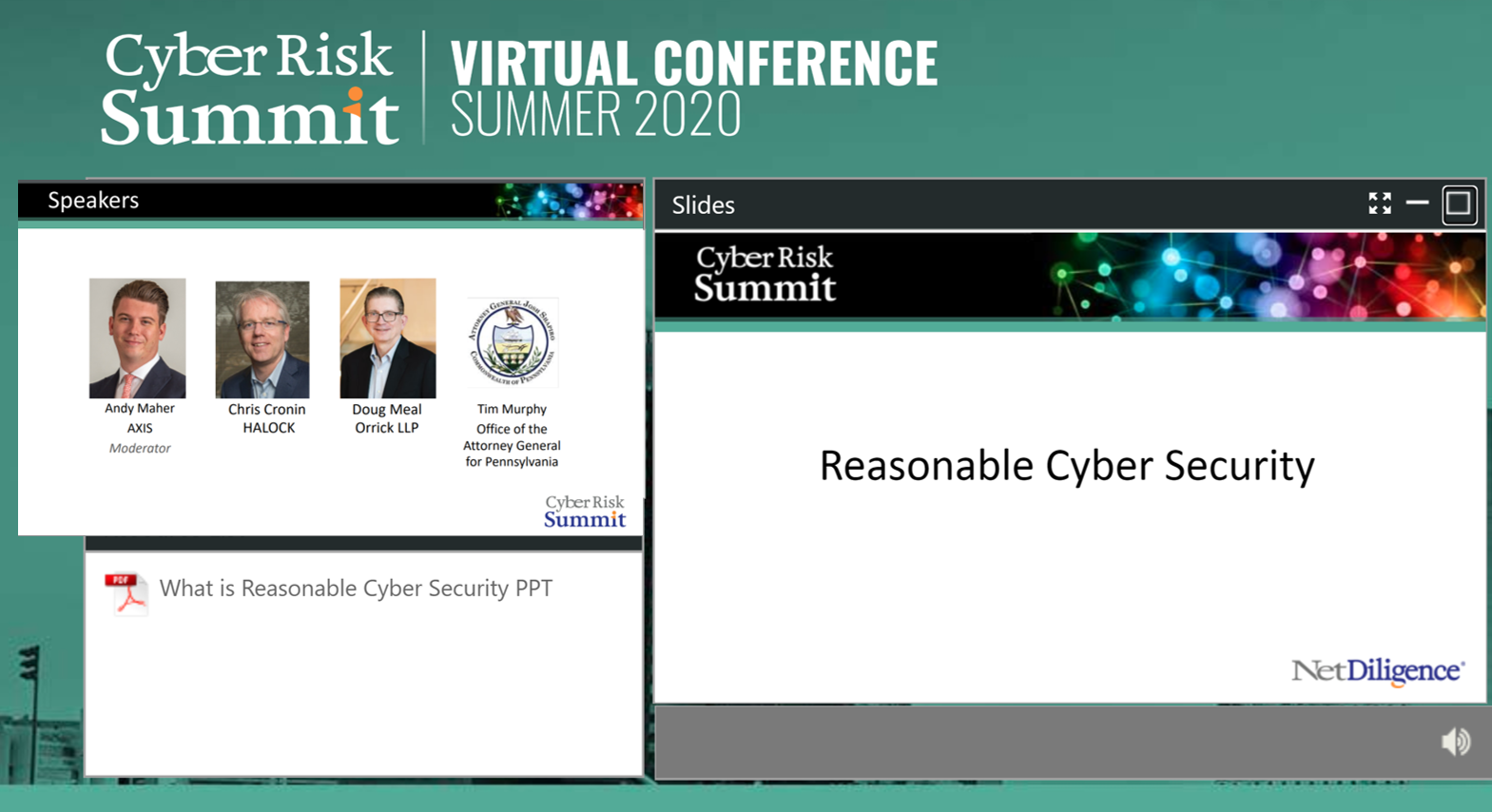
PANELISTS:
- Andrew Maher (M), AXIS
- Chris Cronin, HALOCK Security Labs
- Doug Meal, Orrick LLP
- Timothy Murphy, Office of Attorney General for the Commonwealth of Pennsylvania
A few key slides from the webinar:
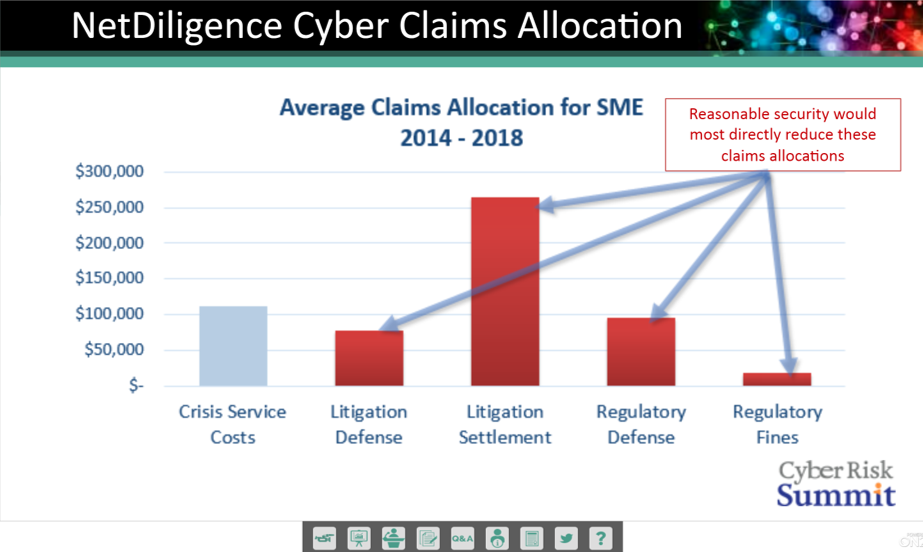
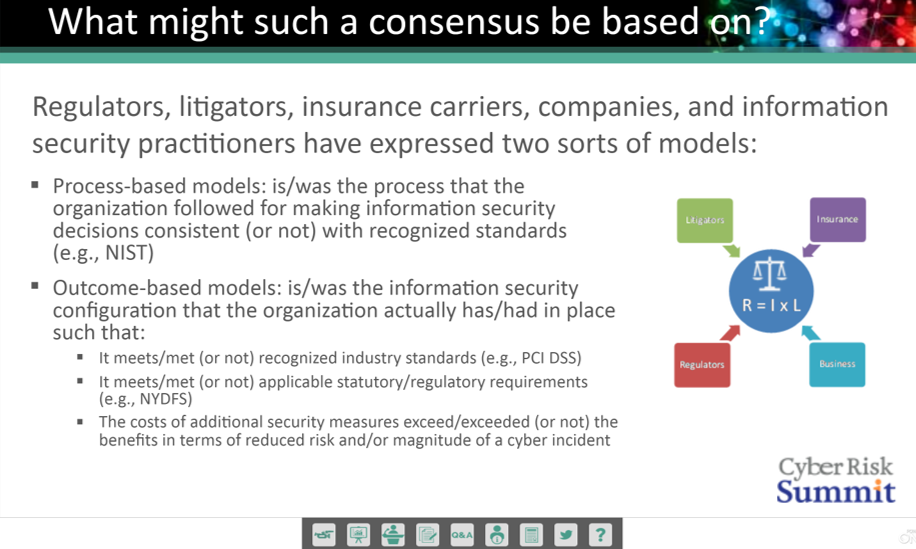
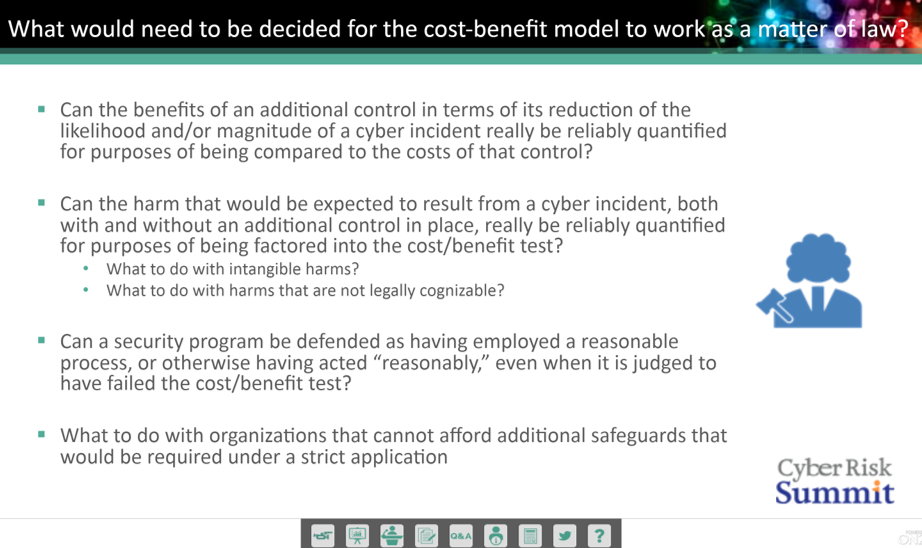
Demonstrate reasonable security through risk engineering/risk-based approach to reduce liability costs.
View the recording.
A few key Q&As from the webinar:
Are there any risk frameworks which quantify risk in the way you’re describing?
CIS RAM by Center for Internet Security provides explicit instructions for how to do risk analysis to demonstrate balance and reasonableness. ISO 27005, NIST 800-30 imply or state that risk analysis should consider risk to self, interested parties, and mission (what courts may think of as “utility”).
Various carriers offer complementary risk engineering services, but insured’s rarely use the opportunity. If carrier’ make their terms subject to, there is push back saying that other markets are not requiring it. Do you think that carriers as a whole should push harder on requiring risk engineering to be completed?
Yes! As an information security practitioner I see regulators and customers respond very well when they see a focused effort on risk reduction over time. The NetDiligence report shows the majority of claims payouts going to liabilities. One of the things I love about insurance is that when it manages risk, everyone wins.
Does PA recognize CIS controls for assessment ?
Yes, PA listed CIS controls by name in a recent settlement along with other industry-appropriate control standards such as NIST and ISO 27001.
Are there cases I can review to better understand Reasonable security?
Pennsylvania’s settlement with Orbitz and Expedia, https://www.attorneygeneral.gov/wp-content/uploads/2019/12/19-12-12-Orbitz-AVC-EFILING.pdf
I am in Medical Technology Cybersecurity. We follow NIST and CIS Controls within the hospitals risk appetite and budget. Less funds available due to Covid19 and reduced revenue.
It would be highly questionable whether “less funds available” would be considered a valid reason for not employing data security measure that would otherwise be considered “reasonable” under industry standards, applicable statutes/regulations, or cost-benefit analysis.
Additionally from Chris:
If you use CIS Controls, then also look at CIS RAM the risk assessment method. They show you how to do this risk analysis.
SOURCE: NetDiligence® Cyber Risk Summit

Frequently Asked Questions (FAQ) on Reasonable Security
Why is “Reasonable” Security Important?
“Reasonable security” language is found in most state and federal privacy laws, and regulators have ruled that you must show you took “reasonable” steps to protect sensitive information.
Reasonable security does not mean perfect security, but rather security that makes sense based on your risks and resources.
Organizations with reasonable security:
- Have a better chance of avoiding regulatory action after a breach
- Are better positioned during litigation and investigations
- Have more support from cyber insurance carriers and adjusters
- Instill more confidence with clients, partners, and stakeholders
What Laws and Regulations Reference “Reasonable Security”?
In the United States, a variety of state and federal laws and regulations require organizations to have “reasonable security practices and procedures.” These include, but are not limited to:
“(3) Grants the business rights to take reasonable and appropriate steps to help ensure that the third party, service provider, or contractor uses the personal information transferred in a manner consistent with the business’ obligations under this title.”
“(5) Grants the business the right, upon notice, including under paragraph (4), to take reasonable and appropriate steps to stop and remediate unauthorized use of personal information.”
“(e) A business that collects a consumer’s personal information shall implement reasonable security procedures and practices appropriate to the nature of the personal information to protect the personal information from unauthorized or illegal access, destruction, use, modification, or disclosure in accordance with Section 1798.81.5.”
“(b) A business that owns, licenses, or maintains personal information about a California resident shall implement and maintain reasonable security procedures and practices appropriate to the nature of the information, to protect the personal information from unauthorized access, destruction, use, modification, or disclosure.
(c) A business that discloses personal information about a California resident pursuant to a contract with a nonaffiliated third party that is not subject to subdivision (b) shall require by contract that the third party implement and maintain reasonable security procedures and practices appropriate to the nature of the information, to protect the personal information from unauthorized access, destruction, use, modification, or disclosure.”
“requiring that companies develop, implement, and maintain reasonable safeguards to protect the security, confidentiality, and integrity of the private information”
(a) A data collector that owns or licenses, or maintains or stores but does not own or license, records that contain personal information concerning an Illinois resident shall implement and maintain reasonable security measures to protect those records from unauthorized access, acquisition, destruction, use, modification, or disclosure.
(b) A contract for the disclosure of personal information concerning an Illinois resident that is maintained by a data collector must include a provision requiring the person to whom the information is disclosed to implement and maintain reasonable security measures to protect those records from unauthorized access, acquisition, destruction, use, modification, or disclosure.
“(4) Reasonable monitoring of systems, for unauthorized use of or access to personal information;”
Controllers must “Use reasonable safeguards to secure personal data.”
“the Gramm-Leach-Bliley Act, sets forth standards for developing, implementing, and maintaining reasonable administrative, technical, and physical safeguards to protect the security, confidentiality, and integrity of customer information.”
“What does a reasonable information security program look like?”
“every reasonable step must be taken to ensure that personal data that are inaccurate, having regard to the purposes for which they are processed, are erased or rectified without delay (‘accuracy’);”
How Do You Demonstrate Reasonable Security?
The most effective way is through a documented, risk-based assessment process that allows you to show how your organization identifies, prioritizes, and mitigates risks.
A legally defensible risk assessment provides a fact-based argument that your actions were prudent, informed, and proportionate.
Key elements include:
- Risk identification: What data, systems, and processes are impacted?
- Threat and vulnerability analysis: What risks are credible and foreseeable?
- Impact assessment: What could cause harm to customers, partners, or operations?
- Control evaluation: What safeguards are reasonable under current conditions?
- Documentation: Written records of your findings, decisions, and mitigations.
Security and legal frameworks such as NIST SP 800-30, ISO 27005, CIS Controls, and DoCRA (Duty of Care Risk Analysis) can help define and prove what “reasonable” looks like in practice.
Is Reasonable Security the Same as Compliance?
No. Compliance meets minimum standards, but reasonable security shows you went above and beyond with due care.
What Is the Duty of Care Risk Analysis (DoCRA)?
The Duty of Care Risk Analysis (DoCRA) standard is an approach to establish and document reasonable security for an organization. It states that reasonable security is:
“Security that balances the interests of the organization with the interests of others who may be harmed if security fails.”
DoCRA helps organizations to review and justify risk decisions, not only from a compliance point of view but also with respect to fairness, proportionality, and legal defensibility. In essence, it considers an organization’s mission, objectives, and obligations. It effectively bridges security, business, and legal aspects in one defensible framework.
How Does HALOCK Help Organizations Demonstrate Reasonable Security?
HALOCK offers cybersecurity assessments that are risk-based, legally defensible, and aligned with the Duty of Care Risk Analysis (DoCRA) standard.
HALOCK assessment helps you to:
- Identify, quantify, and prioritize cyber risks
- Select and balance controls with business impact
- Document a reasonable security posture for regulators, courts, and clients
- Establish an accountability and continuous improvement process

