



Cyber Security In The Healthcare Industry
Patient health information (PHI) and electronic patient health information (ePHI) security are top priorities for organizations, and with good reason. Data shows that healthcare experiences twice the number of cyber attacks as any other industry. Healthcare cybersecurity is constantly evolving as patients and staff require access via mobile devices, while more traditional IT environments, such as on-premise servers, are now high-priority targets for malicious actors hoping to steal medical records and/or blackmail companies for access to their information. Enhance your security strategy to address your changing working environment and risk profile. The increase of virtual doctor appointments, telehealth, and telemedicine, information security has gotten much more complex. Some of the top threats to the healthcare industry are miscellaneous errors, privilege misuse, and system intrusion. The HIPAA update for 2025 proposed a number of requirements, such as annual penetration testing and written incident response plans (IRPs). With the adoption of AI (artificial intelligence) across the industry, organizations must adapt how they manage sensitive data.
How AI and Cybersecurity Risk Are Impacting Healthcare
Healthcare organizations handle massive volumes of sensitive data — from protected health information (PHI) and medical histories to billing and identity data. As healthcare embraces AI and digital tools (for diagnostics, medical-device automation, record-keeping, billing, cloud storage, and more), the “attack surface” expands, bringing new vulnerabilities.
Recent research underscores that AI-based systems in healthcare — including machine learning, large language models, cloud-based AI tools, and ML-enabled medical devices — face serious risks. Those include “data poisoning,” where contaminated data corrupts model training; inference attacks or data-extraction via model APIs; supply-chain risks when third-party AI or vendors are compromised; and vulnerabilities introduced by third-party integrations.
Another critical risk is misuse of AI or “Shadow AI”: for example, staff using public generative-AI tools or non-HIPAA compliant cloud services to transcribe notes or draft patient communications. That can inadvertently expose PHI.
As a result of these changes, healthcare cybersecurity needs to not only address traditional risks such as phishing or ransomware but also the security and safety concerns specific to AI — whether in data handling and model management, or in third-party AI development tools and devices.
Security and Privacy Regulations: HIPAA, Data Protection, and AI
PHI must be secured under HIPAA: its confidentiality, integrity and availability must be maintained when in storage, in processing, and in transmission. If a provider, vendor (or business associate) introduces AI tools, cloud storage, or third-party platforms that are used in their care provision, HIPAA is still applicable, and PHI used for AI model training or processing is still PHI and must be protected accordingly. Experts caution that HIPAA compliance becomes much more complicated with the increased use of AI, especially when many AI tools are not created with HIPAA-grade data protection capabilities (e.g. using public tools or third-party datasets).
Developing Risks You Should Understand:
- Uploading unencrypted, non-tokenized, or non-de-identified data to public or third-party AI tools.
- Sharing PHI with AI vendors or cloud-based ML systems that are not covered by HIPAA Business Associate Agreements (BAAs).
- Insufficient visibility over where PHI goes: data stored in the cloud, shared with vendors, used for AI, or processed by third parties — potentially violating HIPAA data-use and disclosure rules.
- Lack of patient consent or inadequate consent policy updates: traditional consent forms may not cover AI use, data reuse, or sharing for model training.
As a result, when integrating AI, healthcare organizations should treat AI tools as “business associates” (or at least part of the HIPAA regulatory scope), ensuring BAAs, encryption, access control, logging, and monitoring at least meet HIPAA Security Rule requirements.
There is an overall increased risk to our data health. At HALOCK, we’ve developed healthcare data security solutions capable of prioritizing strengthening your risk management program through reasonable security and providing long-term support as your working environment evolves.
“We have a long standing relationship with HALOCK in this area. Assessments are performed flawlessly with meaningful results.”
– Nationally Ranked Pediatric Hospital
INSIGHTS, NEWS, AND BREACHES: HIPAA & HEALTHCARE
The Healthcare Trifecta: Complexity, Compliance, and Cybercrime
There’s a reason healthcare companies face more cyber attacks than those in other industries: The sheer amount of data contained in medical records far outstrips information collected by retail, legal, or financial institutions. These records often include personal information, medical histories, prescriptions, credit card data, and information about next-of-kin or other family members. Thus, when it comes to medical records security, healthcare businesses face the triple threat of complexity, compliance, and cybercrime. Rapidly increasing data volumes from multiple sources grow infosec complexity, while government agencies and standards organizations create new compliance regulations that require reasonable security controls based on mission, objectives, and obligations. Cyber criminals, meanwhile, are leveraging historic weaknesses and developing new threats to compromise healthcare information security. These threats are wide-ranging and can come from a variety of sources. They include brute force attacks against an organization’s firewall as well as more insidious methods such as phishing schemes. Whether the attack comes from exploiting a weakness in your security measures or an attempt to trick employees into unknowingly giving up their credentials, any kind of breach can be a disaster for healthcare organizations.
“HALOCK does good work.”
– Healthcare Association
What We Do
The challenges surrounding healthcare and cybersecurity have never been greater. Fortunately, HALOCK has the expertise and experience to provide the most comprehensive cybersecurity in the healthcare industry through reasonable data governance and security. Our solutions also ensure compliance with government standards for protecting confidential data. HALOCK’s team of industry experts has developed a range of hospital cybersecurity services to help your healthcare organization better manage current issues and prepare for new attacks, including:
- HIPAA Compliance and Risk Assessment: Compliance regulations such as HIPAA are critical to ensure medical records security meets government standards. With the evolution of physician and patient visits through interactive medicine, video conference apps, and software. This has surfaced new vulnerabilities for ePHI, sensitive data, and private information. Understand the HIPAA compliance requirements as they pertain to your healthcare organization. Understand your security and risk profile for your operations, especially with the widespread use of AI.
- PCI Compliance for healthcare is also essential. With the scope of health industry services rapidly expanding, many companies now store and retain at least some credit data, making them subject to PCI DSS requirements. Review your PCI compliance. Ensure you have implemented the proper standards for your specific cardholder data environment (CDE). Understand changes in password requirements, training, Targeted Risk Analysis (TRA), scanning, outsourcing eCommerce, automation, and more. We can help you achieve and maintain PCI Compliance. We can help identify and satisfy key compliance obligations.
- Risk Management Program (RMP): The massive volume of potential healthcare security issues means you need to spend InfoSec budgets wisely to ensure maximum impact and minimum disruption. Our experts have the industry knowledge you need to prioritize and optimize security investments while keeping you compliant. An ongoing risk management program provides continuous maintenance and insight into your risk profile and how to enhance your safeguards, mitigate your risks, and define reasonable security.
- Penetration Testing or Red Teaming: As healthcare IT grows more complex, companies increasingly rely on third-party and open-source solutions to streamline deployments and infrastructure. Penetration testing from HALOCK helps identify potential vulnerabilities and deploy remediation strategies before cyber attackers compromise your network. Before launching a new telemedicine app, validate that it is secure to handle private data. If you have changes on your network or are integrating systems with a recent acquisition, test your changing environment. Test to see if your controls and team can respond appropriately in the event of a breach with an Assumed Breach or Adversary Simulation penetration test. Conduct a remediation verification pen test to confirm vulnerabilities are fixed. Ensure you get a comprehensive penetration testing report that details your results, along with remediation steps to reduce your risk.
Healthcare Web Application Penetration Testing: Offensive Security to Protect Patient Data
- Risk-Based Threat Assessment: Improve protection against the five MITRE ATT&CK Types, like ransomware. Prioritize security controls to enhance or implement using the best threat data the cybersecurity community offers, leveraging the HALOCK Industry Threat (HIT) Index, a model for estimating the most likely (and least likely) ways your organization will be hit by a cybersecurity or information security attack.
- HALOCK’s Cloud Security Assessment: Gain insight into your risks. The assessment provides a review of Azure, AWS, and Google (GCP) cloud environments to identify risks and recommends how to remediate them.
- Healthcare Incident Response: Should you experience a breach, HALOCK has the tools and expertise you need to quickly recover after a security incident and track the problem to its source. HALOCK’s incident response management, process, tabletop exercises, and planning provide comprehensive coverage in the event of a security breach. How your team responds and how quickly they can minimize the risk and impact of a cyber attack. Leverage a compromise assessment to audit your environment or threat hunting (MDR) to monitor threats. Many cyber insurance companies require a written incident response plan (IRP) for coverage. Explore an ongoing program that gets in front of any potential threats or attacks with an Incident Response Readiness as a Service (IRRaaS) approach.
- Mergers & Acquisitions (M&A): As part of the due diligence process of an M&A, organizations must understand the risk and security profile of their partner or target company. You must determine what liabilities or risks can arise under the other company’s cybersecurity program. With HALOCK’s M&A program, we can help you through the entire process from pre-acquisition to post-acquisition to identify risks, remediation steps, and establish reasonable security.
- Risk Assessments: Healthcare regulations require your safeguards to be reasonable for your organization, patients, and partners. With many frameworks available, how do you establish your acceptable risk? Do you know the best risk management strategy for you? HALOCK guides you through a proper HIPAA Risk Assessment. With the release of the Securities and Exchange Commission (SEC) Cybersecurity rules on disclosure, it’s essential that you regularly review your risk profile. The Duty of Care Risk Assessment (DoCRA) helps you define a reasonable security strategy factoring in compliance and safeguards based on your specific facility, objectives, and social responsibility. Leverage a comprehensive Risk Management Program to establish a defensible security strategy.
Surgical Device Cybersecurity: Understanding AI and Medical Device Risks in Healthcare
What is New with AI-Enabled Devices and Cyber Risk?
What’s New in Healthcare Risk and AI?
Why Your Organization Needs Defensible AI and Emerging Tech Risk Management
- Privacy: CCPA is the most sweeping legislation to date in the U.S. that concerns the protection of personal information. It broadens the definition of what constitutes personal information and gives California citizens greater control over what companies can do with their personal data. This includes the right to exempt their own personal information from being shared or purchased on the open market. Understand the impact this change and other states’ requirements have on your organization. Know what private information you manage and where it is located to properly secure it. Conduct sensitive data scanning to ensure you have a current data inventory of sensitive information.
- Legal Advisory: Get the proper support for your legal team when addressing a security incident or litigation. See how we can partner with you in this engagement example of post-breach risk assessment for a university health system.
- Cyber Security Awareness Training: With many employees now working remotely, they are targets for hackers. Ensure they understand the potential threats they may experience and best practices to prevent cyber attacks. Security Awareness training will provide guidance on how to detect suspicious activity and what to do in the event of a security incident.
- Security Engineering & Tools: Ensure you have the proper infrastructure security controls to defend sensitive data of your medical staff, patients, payers, providers, and more. Proactively assess common threats to the healthcare industry through the HALOCK Industry Threat (HIT) Index to best prepare. Conduct security architecture reviews, sensitive data scanning, and implement threat monitoring programs to proactively secure against cyber threats. Ensure you have reasonable controls implemented as mandated by compliance requirements, such as multi-factor authentication (MFA) or web application firewalls (WAF).
- External Attack Surface Management (EASM) service provides continuous discovery, exploit validation, and risk-based prioritization to keep you ahead of threats. With an evolving attack surface, get the visibility and insight to prioritize your security controls.

Why HALOCK for Healthcare? HALOCK and the healthcare industry share common ground — purpose-driven results. For healthcare, this means designing treatment options that target root causes and solve underlying issues. At HALOCK, our purpose-driven security mandate means delivering optimal security in the right place at the right time to boost overall health data security without causing unintended side effects to productivity. When you require reasonable safeguards for healthcare information security, talk to HALOCK for HIPAA compliance readiness consulting.
See our Healthcare Case Study
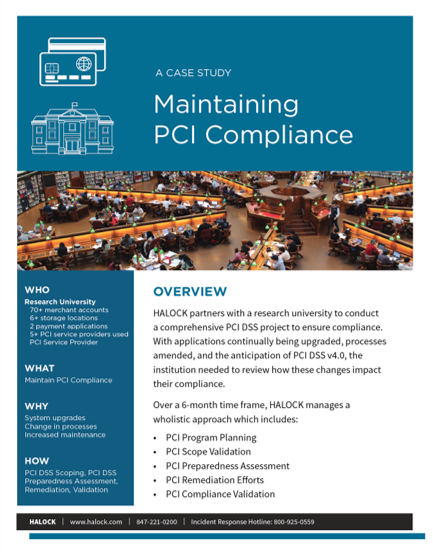
CASE STUDY: Research University
Frequently Asked Questions (FAQs)
What is HIPAA compliance?
This refers to the process for following the procedures required by the Health Insurance Portability and Accountability Act. HIPAA is the law that established the current standards for protecting patients’ sensitive health-related data. The goal is to ensure healthcare companies do everything possible to secure and protect this information to prevent data breaches.
What is a HIPAA-covered entity?
Entities that are required to adhere to the HIPAA standards include healthcare providers, health plan providers, and healthcare clearinghouses. All of these entities are entrusted with patients’ personal information, including Social Security numbers (SSNs), bank account details, and medical histories. Any enterprise that falls into these categories can benefit from HIPAA compliance solutions.
What are HIPAA violations?
There are a number of ways in which a HIPAA-covered entity can fail to comply with regulations. These can include transmitting patient data without sufficient encryption, disclosing patient information to unauthorized entities, or falling victim to cyberattacks that expose the data. The scope of potential violations and the severity of the penalties involved make it all the more important that businesses enlist the help of HALOCK as their HIPAA consultant.
Are there any new HIPAA requirements we should be aware of?
If your organization is responsible for HIPAA compliance, you may have another incentive to begin regular pen testing. That is because on December 24, the Office for Civil Rights (OCR) at the U.S. Department of Health and Human Services (HHS) issued a Notice of Proposed Rulemaking (NPRM) to modify HIPAA. Learn more details in this HIPAA article.
Where can I find a guide to HIPAA Acronyms?
Read a glossary of HIPAA and healthcare acronyms.
What are the top threats facing the healthcare industry?
Top Cyber Threats in Healthcare
What about AI (artificial intelligence) regarding HIPAA?
To successfully approach managing risk in the age of AI, organizations using AI should incorporate reasonable security into their risk strategy.
Establish reasonable security through duty of care.
With HALOCK, organizations can establish a legally defensible security and risk program through Duty of Care Risk Analysis (DoCRA). This balanced approach provides a methodology to achieve reasonable security as the regulations require.
Cybersecurity & Risk News, Updates, Resources
Cybersecurity Awareness Posters
