



Reasonable Risk Management
Simplifying cybersecurity risk management to be more efficient and effective.
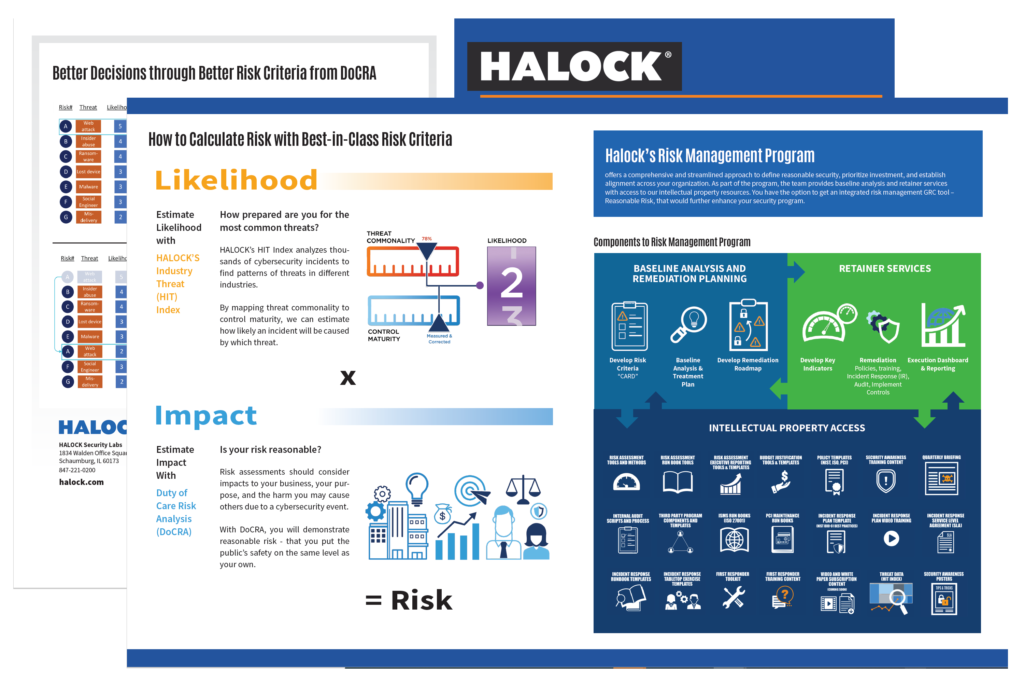
HALOCK’s Risk Management Program
Establishing ‘Reasonable Security’. Regulations and standards require risk assessments and for organizations to practice ‘reasonable security’. Organizations must implement security safeguards that reasonably protect others – that the burden of a safeguard is not greater than the risk it prevents. The Duty of Care Risk Analysis (DoCRA) methodology can accomplish this for you.
Partnering with a Comprehensive Service. HALOCK’s expert team guides you through your custom program – from advisory, status reporting, remediation services, and access to a wealth of intellectual property to best position your organization and keep your executive team informed and involved.
___________________________________
Automating Risk Management through a Proven Governance System™. Reasonable Risk is a SaaS GRC platform designed to help manage and automate an organization’s cybersecurity risk. The platform enables communication of program progress and budget requirements with executive management so that they can make better cybersecurity risk decisions.
“It’s been a game changer for us, in a good way. When we first started working with HALOCK, the mission was simple. I felt that the way we were looking at risk, was very immature, for an organization our size. We work with HALOCK on the methodology, on the Duty of Care, you know, risk analysis process, that production of a risk register. All that was essential. Then we needed a way to translate that. We needed a way to almost automate that. And that’s where the Reasonable Risk tool has really helped us a lot. We’re able to take the findings that come out of our risk register.
We’re able to prioritize those findings, and then we’re able to use Reasonable Risk to really stand up projects, to tie that to NIST controls, to figure out who the accountable officers need to be in the business unit.
And it really gives us an idea where it gives us a true kind of understanding of how we can get to that risk reduction that we’re looking for as an organization.
For example, if I have an associated project that has seven or eight different subtasks and there’s associated risk ratings with each of those, But I know that if I were to complete this remediation plan, it would take me to x score.
You know, that’s very helpful to me. It’s very helpful to my team.
And I think the thing I like about Reasonable Risk too is that the ease of use, is there. We’ve been fortunate to be kind of one of the early adopters the maturity of our program. I’ve worked with other GRC tools before and, just the implementation process for some of those GRC tools took us months. And it was one thing for an information security team or even an IT team to use some of those governance tools. But then when we tried to propagate that to the rest of the organization, it presented another challenge. It was confusing. It was time consuming. It was overly complicated when it didn’t need to be. I know for my team, all twelve people on our team, we all have, visibility. We all use, and we understand how the risk tool can help us, achieve our mission and, continue to, mature the program.”
– CISO, Large Parking Management Company
Schedule a review of your risk profile and see how HALOCK can advance your risk and security program.

Frequently Asked Questions (FAQ) on Reasonable Security
Why is “Reasonable” Security Important?
“Reasonable security” language is found in most state and federal privacy laws, and regulators have ruled that you must show you took “reasonable” steps to protect sensitive information.
Reasonable security does not mean perfect security, but rather security that makes sense based on your risks and resources.
Organizations with reasonable security:
- Have a better chance of avoiding regulatory action after a breach
- Are better positioned during litigation and investigations
- Have more support from cyber insurance carriers and adjusters
- Instill more confidence with clients, partners, and stakeholders
What Laws and Regulations Reference “Reasonable Security”?
In the United States, a variety of state and federal laws and regulations require organizations to have “reasonable security practices and procedures.” These include, but are not limited to:
“(3) Grants the business rights to take reasonable and appropriate steps to help ensure that the third party, service provider, or contractor uses the personal information transferred in a manner consistent with the business’ obligations under this title.”
“(5) Grants the business the right, upon notice, including under paragraph (4), to take reasonable and appropriate steps to stop and remediate unauthorized use of personal information.”
“(e) A business that collects a consumer’s personal information shall implement reasonable security procedures and practices appropriate to the nature of the personal information to protect the personal information from unauthorized or illegal access, destruction, use, modification, or disclosure in accordance with Section 1798.81.5.”
“(b) A business that owns, licenses, or maintains personal information about a California resident shall implement and maintain reasonable security procedures and practices appropriate to the nature of the information, to protect the personal information from unauthorized access, destruction, use, modification, or disclosure.
(c) A business that discloses personal information about a California resident pursuant to a contract with a nonaffiliated third party that is not subject to subdivision (b) shall require by contract that the third party implement and maintain reasonable security procedures and practices appropriate to the nature of the information, to protect the personal information from unauthorized access, destruction, use, modification, or disclosure.”
“requiring that companies develop, implement, and maintain reasonable safeguards to protect the security, confidentiality, and integrity of the private information”
(a) A data collector that owns or licenses, or maintains or stores but does not own or license, records that contain personal information concerning an Illinois resident shall implement and maintain reasonable security measures to protect those records from unauthorized access, acquisition, destruction, use, modification, or disclosure.
(b) A contract for the disclosure of personal information concerning an Illinois resident that is maintained by a data collector must include a provision requiring the person to whom the information is disclosed to implement and maintain reasonable security measures to protect those records from unauthorized access, acquisition, destruction, use, modification, or disclosure.
“(4) Reasonable monitoring of systems, for unauthorized use of or access to personal information;”
Controllers must “Use reasonable safeguards to secure personal data.”
“the Gramm-Leach-Bliley Act, sets forth standards for developing, implementing, and maintaining reasonable administrative, technical, and physical safeguards to protect the security, confidentiality, and integrity of customer information.”
“What does a reasonable information security program look like?”
“every reasonable step must be taken to ensure that personal data that are inaccurate, having regard to the purposes for which they are processed, are erased or rectified without delay (‘accuracy’);”
How Do You Demonstrate Reasonable Security?
The most effective way is through a documented, risk-based assessment process that allows you to show how your organization identifies, prioritizes, and mitigates risks.
A legally defensible risk assessment provides a fact-based argument that your actions were prudent, informed, and proportionate.
Key elements include:
- Risk identification: What data, systems, and processes are impacted?
- Threat and vulnerability analysis: What risks are credible and foreseeable?
- Impact assessment: What could cause harm to customers, partners, or operations?
- Control evaluation: What safeguards are reasonable under current conditions?
- Documentation: Written records of your findings, decisions, and mitigations.
Security and legal frameworks such as NIST SP 800-30, ISO 27005, CIS Controls, and DoCRA (Duty of Care Risk Analysis) can help define and prove what “reasonable” looks like in practice.
Is Reasonable Security the Same as Compliance?
No. Compliance meets minimum standards, but reasonable security shows you went above and beyond with due care.
What Is the Duty of Care Risk Analysis (DoCRA)?
The Duty of Care Risk Analysis (DoCRA) standard is an approach to establish and document reasonable security for an organization. It states that reasonable security is:
“Security that balances the interests of the organization with the interests of others who may be harmed if security fails.”
DoCRA helps organizations to review and justify risk decisions, not only from a compliance point of view but also with respect to fairness, proportionality, and legal defensibility. In essence, it considers an organization’s mission, objectives, and obligations. It effectively bridges security, business, and legal aspects in one defensible framework.
How Does HALOCK Help Organizations Demonstrate Reasonable Security?
HALOCK offers cybersecurity assessments that are risk-based, legally defensible, and aligned with the Duty of Care Risk Analysis (DoCRA) standard.
HALOCK assessment helps you to:
- Identify, quantify, and prioritize cyber risks
- Select and balance controls with business impact
- Document a reasonable security posture for regulators, courts, and clients
- Establish an accountability and continuous improvement process

Learn how Duty of Care Risk Analysis (DoCRA) can help you achieve reasonable security:
What is Duty of Care Risk Analysis (DoCRA) for Cybersecurity?
What is Duty of Care Risk Analysis (DoCRA) for General Counsel?
What is Duty of Care Risk Analysis (DoCRA) for Regulators?
What is Duty of Care Risk Analysis (DoCRA) for Auditors?
What is Duty of Care Risk Analysis (DoCRA) for Executives?
What is Duty of Care Risk Analysis (DoCRA) for Risk Managers?
